When you get a job offer, don’t rush to negotiate right away. Instead, take a moment to pause and prepare. Why? Because over 70% of hiring managers expect negotiation, and 85% of candidates who negotiate receive at least part of what they ask for. However, many people either skip this step or make emotional decisions that leave money or benefits on the table.
Here’s how to approach it:
- Pause Before Acting: Rushing into negotiations can lead to mistakes like focusing only on salary or revealing too much too soon.
- Understand the Full Offer: Evaluate every aspect - salary, bonuses, benefits, PTO, equity, and work-life balance.
- Do Your Research: Use tools like Glassdoor, Levels.fyi, and market data to benchmark your worth.
- Define Your Bottom Line: Know your minimum acceptable terms and prepare a counteroffer based on data.
- Use Negotiation Tools: Platforms like Negotiations.AI and Jobicy’s AI Coach can help you analyze offers and simulate scenarios.
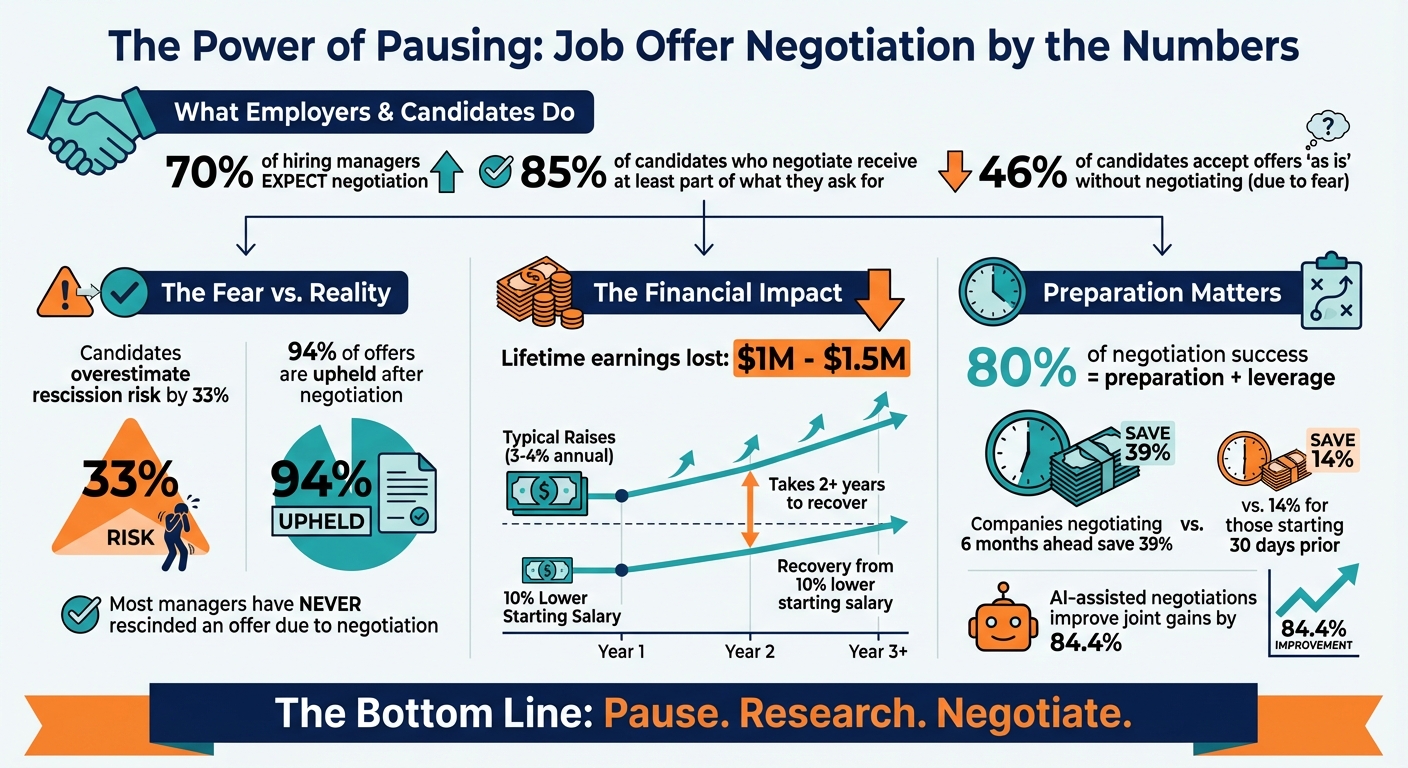
Job Offer Negotiation Statistics and Financial Impact
How to Negotiate Your Job Offer - Prof. Deepak Malhotra (Harvard Business School)

sbb-itb-9cd970b
Why Pausing Before Negotiation Matters
When you get an offer, it’s easy to feel either thrilled or frustrated. But here’s the thing: decisions driven by emotions can backfire. That’s why taking a moment to pause before diving into negotiation is critical. As Aline Lerner, CEO of interviewing.io, points out, negotiation success hinges 80% on preparation and leverage [7]. If you rush in, you’re playing by the other side’s rules, not your own. A pause gives you time to assess the full value of the offer and plan your approach.
What Happens When You Negotiate Too Fast
Jumping into negotiations without preparation can create a domino effect of missteps. For starters, you might zero in on the base salary and completely miss the other perks on the table. Things like health insurance, retirement contributions, paid time off, flexible schedules, and professional development opportunities can add thousands of dollars to your total compensation. But these benefits often get overlooked when you’re reacting emotionally [2].
Another risk? Revealing too much, too soon. If you share your current salary or expectations before fully understanding the offer, you’ve just given the employer a reference point that benefits them - not you. This can lock you into a weaker position, making it harder to negotiate on your terms [7].
And then there’s the fear factor. A surprising 46% of job candidates accept offers “as is” without negotiating because they’re worried the offer might be rescinded [6]. But that fear is largely unfounded. Research shows candidates overestimate the risk of an offer being pulled by 33%. In reality, 94% of offers are upheld, and most managers have never rescinded one due to negotiation [6]. By rushing, you’re not just leaving money on the table - you’re doing it based on a fear that doesn’t align with reality.
The financial impact of skipping negotiation is huge. Over a lifetime, failing to negotiate could cost you $1 million to $1.5 million in earnings [7]. Even a 10% lower starting salary can take years to recover, given that typical annual raises hover around 3% to 4% [1]. Pausing gives you the chance to uncover the full value of the offer and negotiate effectively.
How Taking Time Improves Your Position
Taking a pause isn’t just about calming your nerves - it’s about shifting from emotion to strategy. Instead of reacting to a single number, you can step back and evaluate the full package: base salary, bonuses, equity, benefits, vacation days, and remote work options. Without analysis, you can’t negotiate effectively.
This pause also allows you to do your homework. Researching industry benchmarks on platforms like Glassdoor or Indeed can give you a clear picture of what’s fair. Compare your experience to the job’s requirements and identify areas where you bring extra value. If you exceed the job’s qualifications, you have leverage - especially if you back it up with concrete examples [1]. This preparation sets the stage for advanced negotiation tools discussed later.
Perhaps most importantly, taking time helps you define your bottom line. Career counselor Sharon Belden Castonguay highlights this critical point:
"It's not just about your current paycheck, but your long-term earning potential. If you stay with the same employer, it's likely your future raises and certain benefits... will be based on your salary"
– Sharon Belden Castonguay [1]
Knowing your minimum acceptable offer - your reservation value - gives you confidence to negotiate without feeling pressured.
Finally, pausing lets you consolidate your requests. Among candidates who countered on salary or benefits, 85% successfully secured at least part of what they asked for [1]. However, bringing up new demands in multiple rounds can frustrate hiring managers and strain the relationship. A pause ensures you can present all your requests at once, keeping the negotiation professional and efficient [1].
How to Assess What the Offer Is Really Worth
Before diving into negotiations, take a step back to assess the offer thoroughly. Break it down into key areas like finances, benefits, work-life balance, growth opportunities, and the company's overall health. This will help you see how the offer aligns with your personal and professional goals.
Analyzing Each Component of the Offer
Always request a written offer before starting negotiations. Verbal offers can leave out important details, so having everything in writing ensures you’re working with the full picture [1]. Once you have the document, evaluate these key areas:
Financial components: This includes your base salary, signing bonuses, performance bonuses, stock options, and retirement contributions like 401(k) matching [8][1]. Pay close attention to the base salary since it impacts future raises and retirement savings. Misjudging this can affect your long-term financial trajectory.
Benefits and perks: Look beyond the paycheck to consider health insurance, paid time off (PTO), tuition reimbursement, professional development budgets, and relocation assistance [8][5]. These extras can add significant value to your overall compensation.
Work-life factors: Assess aspects like flexible hours, remote work options, commute time, and expected overtime [8][2]. A higher salary might not be worth it if it comes with a grueling commute or little time for yourself.
Career and growth potential: Think about opportunities for advancement, mentorship quality, the company’s reputation, and the skills you’ll gain [8][5]. Ask yourself if this role sets you up for your next career step or boosts your marketability.
Organizational health: Evaluate the company’s financial stability, job security, workplace culture, and commitment to diversity and inclusion [8][5]. A generous salary won’t matter much if the company isn’t stable or the work environment is toxic.
To make sense of the offer, try the "three numbers" strategy. Define your baseline (the minimum you need to meet financial obligations), your fair market value (based on industry research), and your "thrilled" number (the high end of what you’d love to earn) [1]. With these numbers in mind, you can figure out where the offer stands and identify areas for negotiation.
Finding What You Can and Can't Negotiate
Once you’ve analyzed the offer, sort the components into negotiable and non-negotiable categories.
Negotiable components often include base salary, signing bonuses, equity or stock options, vacation time, relocation assistance, start dates, and flexible work arrangements [1][5][9]. These are areas where you’re likely to have some room to adjust terms.
Non-negotiable components are typically company-wide policies, such as health insurance plans, 401(k) structures, and standardized bonus programs, especially in larger organizations [1][9]. Pushing too hard on these fixed elements could frustrate hiring managers and stall the process.
Here’s an important stat to keep in mind: about 70% of managers expect candidates to negotiate, and 85% of those who do end up with at least part of what they ask for [1]. This shows that a well-prepared, research-backed approach to negotiations can pay off.
To figure out which parts of the offer are flexible, ask polite and direct questions like, "What is the range for this position, and is it negotiable?" or "Is there flexibility in the budget for additional vacation days?" [1][5]. If you hit a hard cap on salary, shift your focus to other areas like equity, PTO, or a signing bonus. Signing bonuses, in particular, are often easier for companies to approve since they’re a one-time expense rather than a recurring cost [9].
When dealing with stock options, ask for details like the total number of outstanding shares or the percentage of the company your grant represents. Without this context, the raw number of shares doesn’t tell you much [9]. Keep in mind that startups might offer more equity and flexibility in titles but lower cash salaries, while established companies tend to provide higher base pay and standardized benefits [8][9].
Finally, consolidate all your negotiation points into one conversation instead of bringing up new requests in multiple follow-ups [1]. This approach shows you’ve done your homework and respects the hiring manager’s time.
Researching Market Data and Industry Standards
To negotiate effectively, you need to know how your offer compares to industry norms. Without this research, you're essentially guessing. Solid market data gives you the confidence to advocate for your worth, backed by evidence. It also helps you pinpoint the best platforms for gathering up-to-date industry information.
Where to Find Reliable Market Data
Start by building on your initial offer analysis and diving into platforms that specialize in market trends. For tech roles, Levels.fyi is a great resource. It provides detailed insights into total compensation, including base salary, RSUs (Restricted Stock Units), and bonuses. Plus, it helps you navigate the differences in leveling systems across companies, which can vary widely [4]. For roles outside tech, platforms like Glassdoor, Indeed, and Robert Half can give you a broader view of salary ranges based on your role and experience [1].
When researching, focus on labor costs rather than personal living expenses. Levels.fyi explains:
"Cost of living is subjective and varies greatly depending on the preferences and standard of living of the candidate. Whereas, cost of labor is determined by the market and what companies in a given area are willing to pay in exchange for certain skills" [4].
This is a crucial distinction because recruiters base their offers on what competitors are paying for similar skills - not on your personal financial needs.
Pay transparency laws in states like California and Massachusetts can also work in your favor. In these states, recruiters are required to disclose salary ranges [4]. Don’t hesitate to ask directly: "What is the salary range for this role?" [4].
For additional benchmarks, check resources like the Bureau of Labor Statistics (BLS) Occupational Outlook Handbook, Salary.com, and Payscale. These tools can help you confirm you're in the right ballpark.
Using Benchmarks to Support Your Case
Once you've gathered your data, use it strategically. For example, if a job posting asks for 3–5 years of experience and you have 5, you can argue for compensation at the top of the salary range [1]. When presenting a counteroffer, reference your research directly. For instance, you might say: "Based on data from Levels.fyi and Glassdoor, the market rate for this role with my experience in this region is between $120,000 and $140,000." [5].
Keep in mind that compensation can vary significantly depending on a company's size, industry, and stage. For instance, a software engineer at a product-focused firm like Meta is likely to command a higher salary than at a small non-profit [4]. Consider factors like the company's mission, its funding stage, and how central your role is to its business. If you're weighing a startup offer against one from a large public company (such as FAANG - Facebook, Amazon, Apple, Netflix, Google), remember that big firms often discount startup equity by as much as 75% due to its lack of guaranteed liquidity [4].
Armed with this data, you're not just asking for more; you're presenting a well-reasoned case that’s hard to overlook.
SaaS and AI Tools for Offer Analysis
Once you've gathered your market data, the next step is crafting a solid negotiation strategy. This is where AI and SaaS platforms come into play, breaking down every part of an offer - from salary to benefits - and simulating various negotiation scenarios. These tools help you focus on key negotiation concepts like BATNA (Best Alternative to a Negotiated Agreement) and ZOPA (Zone of Possible Agreement) [10]. By combining these insights with your market research, you can develop precise, scenario-based strategies for negotiation.
AI Tools for Market and Offer Analysis
Negotiations.AI is a platform designed to help you define three critical points: your "Target" (the best realistic outcome), "Acceptable" (what you'd sign today), and "Walk-away" (when to pivot to your BATNA). It quantifies tradeoffs, such as swapping a longer contract for higher equity [10]. With a free trial available, it’s an excellent tool for anyone preparing for high-stakes negotiations [10].
Jobicy's AI Offer Negotiation Coach evaluates both financial and non-financial benefits - like remote work options or professional development stipends - to calculate the total value of an offer [13]. It even provides tailored negotiation scripts in different styles, such as Diplomatic, Confident, or Direct, to match the company's culture [13]. This service is available for $8/month with the Plus subscription [13].
For SaaS contracts, Vendr's AI agent "Ruth" taps into a vast database of over 16,000 suppliers and 1 million price points to provide benchmarks [12]. Vendr has reportedly saved companies over $1 billion by identifying hidden savings and comparing quotes to real market data [12]. A free version of Ruth is available, with additional enterprise-level support offered through Vendr Pro [12].
Modeling Different Negotiation Scenarios
Once you’ve explored the tools, it’s time to simulate and prepare for potential objections. Negotiations.AI allows you to role-play scenarios like hearing “We can’t go any lower” or “This offer expires Friday.” These simulations help you refine your strategy and practice staying composed under pressure [10].
Compa Technologies specializes in enterprise compensation analysis using "Analyst Agents." These agents pull real-time market data from over 9 million observations across 50+ countries [14]. Athar Siddiqee, VP Total Rewards at Micron Technology, highlights its value:
"Compa is the best and most effective way to obtain real-time market data... as opposed to a guesstimate of what's competitive based on aged survey data." – Athar Siddiqee [14]
For recruiters and hiring managers, Compa’s "Partner Agents" can predict how competitive an offer will be before it’s even extended [14][11].
Before diving into simulations, set clear negotiation parameters. Every concession you’re willing to make should be tied to a specific request. For example, if a company insists a salary is non-negotiable, use AI tools to identify other levers like additional vacation days or a professional development stipend [13]. These simulations ensure you’re prepared to negotiate effectively and strategically, always aiming to trade, not give away.
Defining Your BATNA and Minimum Acceptable Terms
Before stepping into any negotiation, it's crucial to define your BATNA - your Best Alternative to a Negotiated Agreement. This is essentially your backup plan if the deal falls through. As Margaret Neale, Professor at Stanford GSB, explains:
"The goal is not to get a deal; the goal is to get a good deal." [3]
To figure out your BATNA, follow these four steps: list all possible alternatives if the negotiation fails, evaluate the value and practicality of each option, choose the best one, and calculate your reservation value (the minimum you'd accept) [15]. For example, when negotiating a job offer, your BATNA might include staying at your current job, pursuing another offer, or ramping up your job search efforts. Once you’ve identified your BATNA, focus on improving those alternatives to strengthen your position.
Strengthening Your Alternatives
Having a solid fallback is just the start. To maximize your leverage, work on improving your alternatives. Relying on just one backup plan can leave you vulnerable, so aim to have multiple BATNAs [15]. Before the negotiation, take actionable steps like securing a competing offer or researching salary benchmarks through recruiters and your professional network [15][3]. While salary websites can give you a general idea, the most accurate insights often come from people in roles similar to yours [3].
When comparing offers, ensure you're evaluating them on equal terms. For example, a competing job offer with a lower base salary but better benefits might actually provide more overall value than it first appears [16].
Determining Your Walk-Away Point
With your research and analysis in hand, establish your walk-away point, which is determined by your reservation value - the absolute lowest offer you're willing to accept [15]. This is vital because your starting salary often sets the baseline for future raises, retirement contributions, and even offers from future employers [1]. For instance, accepting a salary that's 10% below market value could take more than two years of standard 3% to 4% annual raises to make up the difference [1].
To define this walk-away point, use the Three-Number Strategy:
- Baseline: The minimum income you need to cover financial obligations.
- Fair Market Rate: What your research shows people with your skills and experience are earning.
- Thrilled Number: The high end of your salary range that would genuinely excite you [1].
As Sharon Belden Castonguay, Career Counselor, notes:
"It's not just about your current paycheck, but your long-term earning potential. If you stay with the same employer, it's likely your future raises and certain benefits, like retirement contributions, will be based on your salary." [1]
Building a Counteroffer Based on Data
Once you’ve identified your alternatives and determined your walk-away point, it’s time to craft a counteroffer that’s grounded in solid research. The goal here is to pull together everything you’ve learned - market data, total compensation comparisons, and your BATNA (Best Alternative to a Negotiated Agreement) - into a proposal that balances your priorities with the employer’s flexibility.
Start by collecting 10 to 15 specific data points from platforms like Levels.fyi, Glassdoor, and Salary.com, ensuring the information is tailored to your role, experience level, and location [19]. Organize these details into a clear table to define a realistic and defensible range. Career strategist Jenny Foss notes, "Unless a company flat out says 'we're at the top of our range' when they present you your offer, there is almost always room to move" [18]. In fact, most companies leave a 10% to 20% buffer in their initial offers for negotiation [19]. And here’s an encouraging stat: 85% of candidates who negotiate on salary or benefits end up getting at least part of what they request [1]. As Nick Singh, co-author of Ace the Data Science Interview, puts it, "Thirty seconds more thinking about something before you respond can lead to $30,000" [17]. This thoughtful preparation ensures you’re ready to present a professional and well-supported counteroffer.
Presenting Multiple Options (MESO)
Rather than focusing on a single number, consider using the MESO (Multiple Equivalent Simultaneous Offers) approach. This strategy involves presenting multiple compensation packages that all meet your target total compensation but differ in structure. For instance, if your goal is $250,000, you could propose:
- A higher base salary with moderate equity
- A lower base salary with higher equity and a signing bonus
- A balanced mix of base salary, equity, and annual bonus [4]
This approach works because it gives the employer flexibility to choose an option that fits their budget while still meeting your goals. Companies often have more room to maneuver with equity or signing bonuses than with base salaries, so offering several paths increases the likelihood of reaching an agreement [4]. If there’s resistance on base pay, you can shift the conversation to areas like signing bonuses or faster equity vesting to maintain your overall compensation target [19].
Staying Flexible While Holding Your Boundaries
While presenting structured options demonstrates flexibility, it’s equally important to stick to the boundaries you’ve set during your preparation. If the employer can’t meet your minimum acceptable terms - your reservation value - be ready to walk away and pursue your BATNA. Flexibility doesn’t mean compromising on your bottom line; it means exploring creative solutions within your defined limits.
Consider negotiating for non-monetary perks if the employer can’t meet your salary expectations. These might include a professional development budget, a home office stipend, extra PTO, or an accelerated performance review that could lead to an early raise [19]. You might also request insight into the company’s internal salary bands for your role to understand your current position and future growth potential [17]. The key is to stay collaborative and solutions-focused while making it clear you’ve done thorough research. As Rebecca Andersen, Director of Career Services at UC Berkeley, explains: "Negotiating for a better deal may show you're skillful at communicating, assertive and willing to advocate for yourself - qualities most employers want" [17].
Conclusion
When you receive an offer, take a moment to pause - this is where successful negotiation begins. That brief pause turns reactive instincts into strategic decisions. And the numbers prove it: companies starting negotiations six months ahead of a deadline achieve savings of up to 39%, compared to just 14% for those beginning only 30 days prior [22]. The same holds true for personal negotiations - careful preparation often leads to better results. This initial pause sets the tone for using modern tools to enhance your negotiation strategy.
Speaking of tools, SaaS and AI solutions have transformed the way offers are prepared, shifting from guesswork to precise, data-driven methods. Platforms powered by data uncover hidden opportunities and let you simulate negotiation scenarios with accuracy. For example, in late 2025, a procurement lead saved over $300,000 across three vendors by leveraging benchmark intelligence that compared pricing data from more than 10,000 contracts [20]. The impact is even more striking when AI is involved: outcomes improve significantly when one side uses AI-driven research, and joint gains can rise by 84.4% when both sides utilize these tools [21].
Beyond tools and preparation, your mindset plays a pivotal role. As MIT Sloan Professor Jared R. Curhan highlights:
"Our research suggests that pausing silently can be a simple yet very effective tool to help negotiators shift from fixed-pie thinking to a more reflective state of mind" [23].
This reflective approach, combined with solid data and well-defined alternatives, empowers you to present options confidently, stick to your boundaries, and secure agreements that align with your true value.
FAQs
Why should you take a moment before negotiating a job offer?
Taking a moment to step back before diving into job offer negotiations is incredibly important. It allows you the time to carefully assess the details of the offer - everything from salary to benefits and other perks. Plus, it gives you the chance to compare the offer against industry standards and market benchmarks to see how it stacks up.
This pause isn’t just about evaluation; it’s about preparation. It lets you gather the right information, craft a solid negotiation strategy, and avoid rushing into decisions you might regret later. With a well-thought-out plan, you’re far more likely to negotiate terms that align with your career aspirations and financial needs.
What parts of a job offer can you negotiate?
When you're evaluating a job offer, there are several aspects you can potentially negotiate. These often include salary, bonuses, stock options, and benefits such as health insurance or retirement plans. Beyond compensation, you might explore options like flexible work hours, remote work opportunities, paid time off, or other perks the company may offer.
Negotiating effectively requires careful preparation. Focus on what matters most to you, but make sure your requests are reasonable and align with industry standards as well as the company’s policies. Doing your homework ahead of time can help you secure an offer that better fits your needs.
How can AI tools help you evaluate and negotiate a job offer?
AI tools make evaluating and negotiating job offers much easier by offering data-backed insights and tailored advice. They allow you to compare job offers against market standards, like salary ranges for similar positions across the U.S., while also helping you assess the full compensation package - including benefits, bonuses, and perks. This way, you get a clear picture of the offer's actual value.
These tools go a step further by helping you prepare for negotiations. They can recommend ideal counteroffers or strategies based on your background and the employer's usual practices. Some even simulate negotiation scenarios, giving you a chance to practice and boost your confidence. By cutting out the guesswork and emotional bias, AI tools equip you to make well-informed decisions and negotiate with greater confidence.