Pushing problems aside kills trust - and deals. When companies promise to "fix it later", they risk losing credibility, slowing sales, and frustrating buyers. A single oversight, like sending an AI-generated pitch riddled with errors, can derail negotiations. Buyers expect clear solutions upfront, not vague assurances. Without trust, deals stall or collapse entirely.
Key Takeaways:
- Lost Revenue: Delayed fixes lead to longer sales cycles and higher costs.
- Damaged Trust: Buyers lose confidence when issues aren't addressed early.
- Warning Signs: Vague commitments, skipped demos, and unclear technical fit signal trouble.
- Solutions: Use Mutual Action Plans, involve Customer Success early, and track commitments with AI tools.
By addressing issues head-on and prioritizing transparency, you build stronger partnerships and close deals faster. Stop deferring problems - solve them now, and success follows.
#1 TRUST Killer That Will Lose You Sales
Why 'We'll Fix It Later' Damages SaaS and AI Deals
The "fix it later" mindset might seem harmless at first, but it often snowballs into bigger problems. What starts as a small shortcut can quickly turn into technical debt, operational headaches, and, most importantly, a loss of trust with customers. Let’s break down how this approach can lead to lost revenue and frustrated buyers.
Lost Revenue and Delayed Closures
When companies dismiss concerns with promises of "fixing it later", they unintentionally slow down their sales process. Prospects end up spending more time trying to understand the product, which can stretch sales cycles and even derail deals entirely [2].
For AI vendors, rushing to market without addressing key issues often results in poor differentiation and lower win rates [4]. Add inconsistent messaging and mounting technical debt, and you’re looking at increased customer acquisition costs (CAC) and longer payback periods [2][3][4].
CIOs, who are typically cautious decision-makers, are especially reluctant to invest in products with unclear ROI. Unresolved bugs or security concerns make them hesitant, leading to postponed decisions - or worse, a complete withdrawal from the deal [3][5].
Damaged Trust and Buyer Frustration
The financial impact is just one side of the coin. Pushing fixes to the back burner can seriously damage customer trust. When companies fail to deliver on promises to address issues, users lose confidence. Poor app performance only worsens retention, making it harder to maintain momentum [6]. Over time, customers start expecting glitches as the norm and may eventually abandon the product altogether [6].
Frequent, poorly vetted updates can also overwhelm IT teams, creating frustration and driving up churn rates [3]. And then there’s the issue of security. A single lapse can lead to breaches, destroying trust and inviting regulatory scrutiny [1][6].
For AI products, trust hinges on more than just a sleek user interface. Buyers need to see that the underlying logic is solid and that the system can handle failures gracefully. Focusing solely on surface-level features while ignoring core functionality only leads to confidence erosion down the line [7].
Spotting the "We'll Fix It Later" Warning Signs
Now that we've covered the hefty costs of putting off fixes, it's time to look at the early warning signs that pop up during sales conversations. Catching these signals early can save you from the headaches of deferred fixes and keep the trust alive that's crucial for closing deals.
Vague Stakeholder Commitments
When prospects respond with phrases like "We need to figure out…" - especially when it involves decision-makers, budgets, or use cases - take it as a red flag. A study of 25,537 B2B sales conversations showed that these kinds of responses are strongly linked to deals failing to close on schedule [9].
"When a potential customer responds to your timing question with some variation of 'We need to figure out ___________,' there is a sharply negative correlation in getting the deal closed within your estimated forecast." [9]
Non-verbal cues - like sighs or long pauses - can also hint at unspoken hesitations [8]. And when you hear something like "Now is not a good time," it’s often a sign that your solution isn’t a top priority, the prospect isn’t fully convinced, or there are unresolved internal challenges [10]. These behaviors are classic indicators of a "fix it later" mindset.
Repeated Demo Postponements
If demos keep getting pushed back or key stakeholders repeatedly skip technical discussions, it’s a strong signal of declining interest. Frequent rescheduling or low attendance often means the prospect doesn’t see your product as a pressing need [11].
Unverified Technical Fit
Technical issues can be especially tricky because they tend to hide behind initial enthusiasm. For instance, if a vendor can’t clearly explain payment terms or why customers would stick around, it points to an unclear revenue model. Similarly, if the pitch leans on buzzwords like "We use AI" without showing tangible results - such as faster processes, cost reductions, or automation benefits - it signals a lack of proven technical fit [13].
Products that require overly long prompts or constant tweaking frustrate users [13]. And when teams across product, engineering, and sales don’t share a unified definition of success, the solution is unlikely to meet actual user expectations [12]. These are all signs that the product might not deliver what it promises.
How to Avoid the 'Fix It Later' Trap
Once you've identified the warning signs, the next step is to put strategies in place that ensure accountability and prevent problems from being pushed aside. The secret lies in structuring your sales process so that issues can't be swept under the rug.
Use Mutual Action Plans
A Mutual Action Plan (MAP) is a document that outlines the tasks for both parties, complete with specific dates, assigned owners, and deliverables. This type of plan ensures that everyone commits to clear, actionable steps with firm deadlines. For instance, if technical validation is required, the MAP will specify who is responsible, the timeline for completion, and how success will be measured. By removing any ambiguity, a MAP keeps all parties accountable and ensures that critical steps are completed before moving forward.
Use AI Tools for Commitment Tracking
AI-powered CRM systems are great for staying on top of commitments. These tools can automatically flag missed deadlines or delayed follow-ups by monitoring emails, meeting notes, and calendars. If a demo is rescheduled or a promised update doesn’t happen, the system alerts you right away. Catching these issues early allows you to address them before they escalate and potentially derail a deal.
Involve Customer Success Early
Incorporating your Customer Success (CS) team into sales conversations before the contract is signed can completely change the game. When prospects see that you're already thinking about their onboarding and long-term success, it sends a strong message: you’re invested in more than just closing the deal. This approach resonates with buyers - 86% of B2B buyers are willing to pay more for exceptional service, with some even spending up to 30% extra for a superior overall experience [14].
"Those companies that prioritize their customers and go above and beyond to service their customers are the ones that achieve real client retention" [14].
Early involvement of the CS team also ensures that technical concerns and implementation questions are addressed upfront. When your sales and CS teams align on buyer needs and success metrics from the beginning, it builds trust and eliminates the "we'll figure it out later" mindset. These strategies keep deals on track and ensure that no issues are left unresolved.
sbb-itb-9cd970b
Case Study: Closing a $100,000 Deal Without 'Fix It Later' Promises
In Q2 2024, a mid-sized enterprise software company was in the middle of negotiating a $100,000 annual contract with a financial services firm. Things were moving along until the buyer's IT team flagged concerns about how the software’s API would integrate with their existing compliance systems. Initially, the sales team suggested resolving these technical issues during the implementation phase. But this approach didn’t sit well with the procurement committee, who immediately saw it as a red flag.
Realizing the deal was at risk, the sales team shifted gears. They developed a Mutual Action Plan - a detailed roadmap that addressed the technical requirements upfront. This plan included assigning engineers to validate integrations and setting firm deadlines for key milestones. Within two weeks, both parties confirmed that all API integrations would work as needed. The plan also covered critical steps like timelines for data migration, security audits, and user training.
This proactive approach gave the procurement team confidence. By showing clear steps to mitigate implementation risks, the sales team eliminated the uncertainty that often derails enterprise deals.
The result? The contract was finalized just three weeks after the Mutual Action Plan was put into place. Even better, the client went live two weeks ahead of schedule. The seamless onboarding process strengthened trust, which led to a $35,000 expansion in Year Two.
This success story highlights the power of replacing vague promises with a concrete plan and clear deliverables. By removing guesswork, the sales team not only closed the deal but also set the stage for a lasting, trust-driven partnership.
5 Strategies to Eliminate 'We'll Fix It Later' for Good
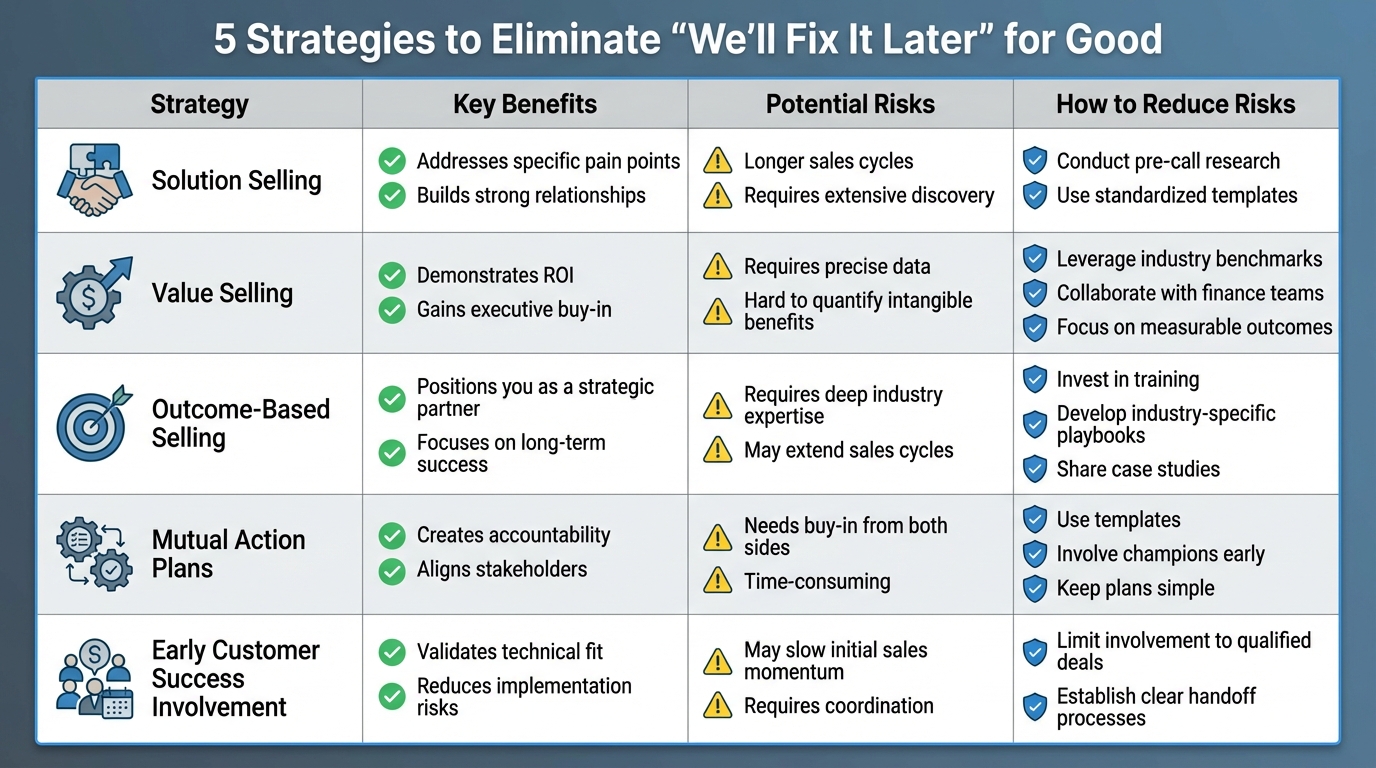
5 Sales Strategies to Eliminate Fix It Later Promises
Top-performing sales teams rely on clear, repeatable strategies to address issues upfront, build trust, and close deals faster. Here are five approaches that directly combat the "fix it later" mindset.
Solution Selling focuses on identifying and addressing the customer’s core challenges. By conducting a thorough discovery process, you can uncover real pain points and deliver tailored solutions that avoid the need for deferred fixes. Value Selling, on the other hand, emphasizes quantifying ROI and efficiency gains early in the process. By demonstrating tangible value upfront, this strategy eliminates the need for vague promises.
Outcome-Based Selling positions you as a trusted advisor who prioritizes the customer’s long-term success. This approach is particularly effective in enterprise deals, where 87% of business buyers expect sales reps to act as strategic partners [15]. It aligns your promises with meaningful results, ensuring a focus on outcomes rather than short-term fixes. Mutual Action Plans complement outcome-based selling by turning high-level objectives into specific milestones with shared accountability. Together, these strategies ensure long-term goals are supported by actionable steps, reducing the risk of unmet commitments. Lastly, Early Customer Success Involvement strengthens retention and accelerates implementation timelines by validating technical requirements during the sales process. This reduces post-sale friction and builds confidence in your ability to deliver.
Strategy Comparison Table
Below is a comparison of the benefits, risks, and ways to mitigate challenges for each strategy:
| Strategy | Key Benefits | Potential Risks | How to Reduce Risks |
|---|---|---|---|
| Solution Selling | Addresses specific pain points; builds strong relationships | Longer sales cycles; requires extensive discovery | Conduct pre-call research; use standardized templates |
| Value Selling | Demonstrates ROI; gains executive buy-in | Requires precise data; hard to quantify intangible benefits | Leverage industry benchmarks; collaborate with finance teams; focus on measurable outcomes |
| Outcome-Based Selling | Positions you as a strategic partner; focuses on long-term success | Requires deep industry expertise; may extend sales cycles | Invest in training; develop industry-specific playbooks; share case studies |
| Mutual Action Plans | Creates accountability; aligns stakeholders | Needs buy-in from both sides; time-consuming | Use templates; involve champions early; keep plans simple |
| Early Customer Success Involvement | Validates technical fit; reduces implementation risks | May slow initial sales momentum; requires coordination | Limit involvement to qualified deals; establish clear handoff processes |
Conclusion: Build Trust, Close Deals, and Deliver Value
The "fix it later" approach doesn't just chip away at trust - it chips away at revenue too. With 96% of surveyed leaders expecting AI to reshape their sales organizations in the next 1–2 years [18], the race to close deals can feel relentless. But rushing to seal the deal without addressing critical details can backfire, undermining both credibility and long-term success.
As we've seen, precision matters. Tackling technical concerns during the sales process and leveraging your CRM to document commitments, track interactions, and maintain accountability are essential steps [16].
The numbers paint a clear picture: only 7% of teams achieve forecast accuracy above 90%, while most hover between 70% and 79% [19]. Why? Because too often, vital conversations are postponed until after the sale. By sticking to your strategies and addressing issues upfront, you can avoid the pitfalls of deferred fixes.
"Remember, you're the expert. You're teaching your customers something they don't know, and you get to step into that trusted advisor role by being excellent at what you already do." – David Ruggiero, President of GTM [17]
It's time to stop pushing problems down the road. Instead, focus on delivering real results now. Deals closed with honesty today pave the way for referrals and renewals tomorrow. When you choose transparency over shortcuts, you're not just closing deals - you’re building relationships that last.
FAQs
Why does the 'fix it later' mindset hurt SaaS and AI sales?
The "fix it later" mindset can be a serious roadblock in SaaS and AI sales. It chips away at trust, weakens credibility, and can ultimately cause deals to collapse. Buyers today demand transparency and dependability - if you delay addressing key issues, it might make them doubt your dedication to providing real value.
This mindset is even riskier when it comes to AI-driven tools. Unchecked or inaccurate information can snowball into major problems, leading to costly errors. Tackling concerns head-on not only builds trust but also ensures clear communication, paving the way for smoother and more successful deal closures.
What are the early signs that a deal might fall through due to unresolved issues?
Spotting warning signs early can save a lot of headaches down the line. Look out for things like unclear communication, missed commitments, or unresolved issues with products or services. If a customer seems hesitant or uncertain during negotiations, it might hint at deeper concerns or a lack of alignment.
By addressing these signals right away, you can build trust, set clear expectations, and keep the deal moving forward smoothly.
How can businesses overcome the 'fix it later' mindset in their sales process?
To move past the "fix it later" mindset, businesses need to focus on clear communication and immediate accountability during sales conversations. Setting honest expectations from the start and openly discussing potential challenges can go a long way in building trust and reliability with clients.
Sales teams should be encouraged to actively track their commitments and consistently deliver on their promises. Creating a work culture that emphasizes quick problem-solving and acknowledges small, early wins can help reinforce this proactive approach. By addressing issues promptly, businesses not only reduce the risk of missed opportunities but also lay the groundwork for stronger, lasting customer relationships.
Related Blog Posts
- The dirty truth about AI valuation: 80% of 'AI-enhanced' companies see NO valuation increase. Here's why the other 20% get all the exits
- The AI Co-pilot: How AI Agents are Empowering Sales Leaders to Hit Exit-Level Targets
- Why AI Integrated SaaS Companies Are Closing Bigger Deals
- Are You Leaving Millions on the Table? How Mid-Market SaaS Firms Can Bridge the Value Gap