AI isn’t replacing software - it’s making it so efficient that seat-based pricing models are no longer sustainable. When fewer employees are needed to achieve the same results, businesses require fewer software licenses. This shift is forcing SaaS companies to rethink their pricing strategies.
Key takeaways:
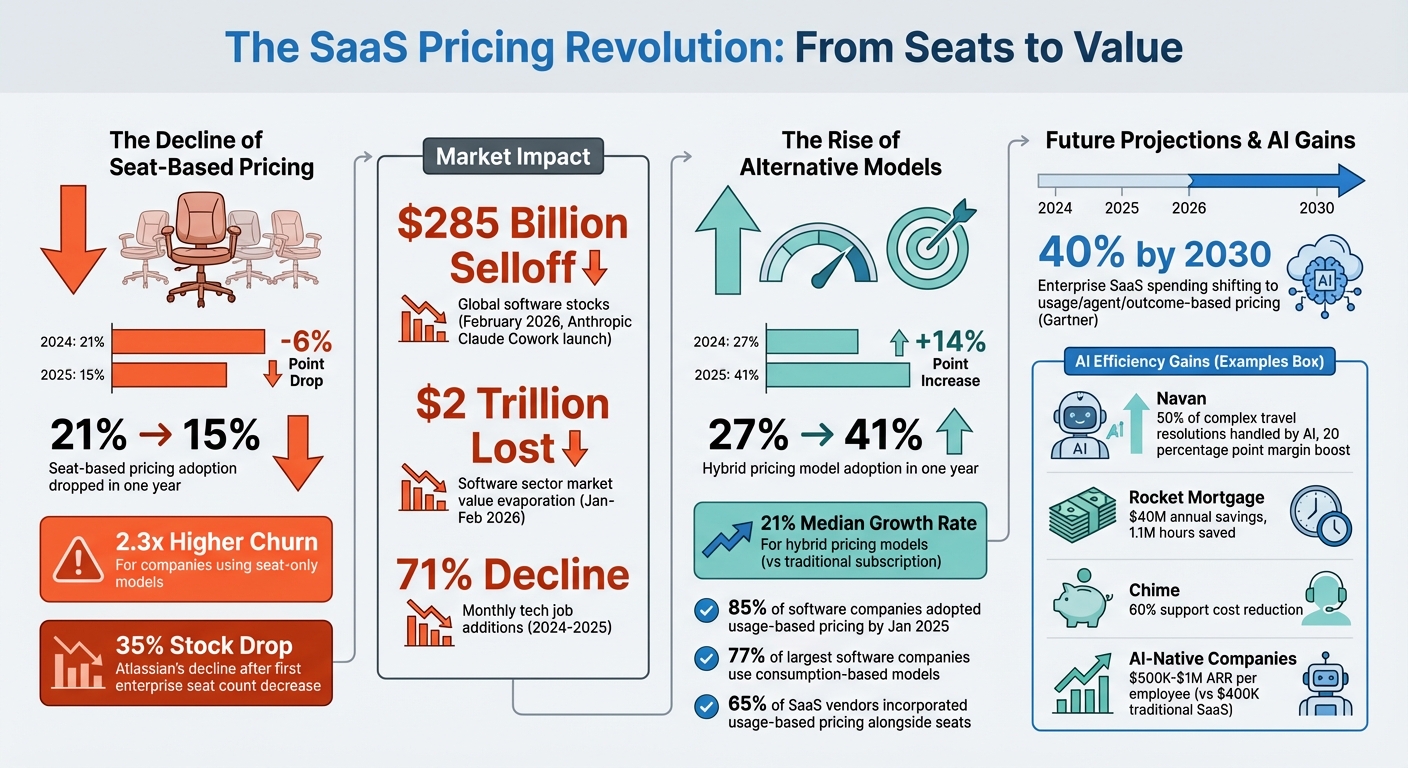
- Seat-based pricing dropped from 21% to 15% in one year, with churn rates 2.3x higher for companies sticking to this model.
- By 2030, 40% of enterprise SaaS spending will shift to usage-, agent-, or outcome-based pricing.
- Hybrid pricing models combining seat- and usage-based elements are growing, with a median growth rate of 21%.
The solution? Transition to usage-based, outcome-driven, or hybrid pricing models. This aligns revenue with the value your software delivers, not the number of users. Companies like Salesforce and Intercom are already leading this charge with models focused on measurable outcomes and AI-driven efficiencies.
The clock is ticking for SaaS vendors relying on outdated pricing. Start by identifying clear value metrics, testing hybrid approaches with select customers, and preparing for a future where AI reshapes how software delivers value.
The Shift from Seat-Based to Usage-Based SaaS Pricing: Key Statistics and Trends
Why Seat-Based Revenue Models Are Failing
How AI Reduces Seat Counts Without Replacing Software
AI isn’t here to replace software - its role is to make software more efficient. This efficiency means companies need fewer users to achieve the same results. For example, when AI handles half of all complex travel resolutions or fully resolves customer support tickets, businesses can cut back on staff, which in turn reduces the need for software licenses. The software itself remains critical, but the number of seats required drops significantly.
"The better your AI features work, the fewer seats customers need. You have built a product that erodes its own revenue model." - Tierly.app [4]
Take Navan, for instance. In February 2026, the company reported that AI agents were managing about 50% of complex travel resolutions. This shift from human service costs to compute costs boosted their gross margins by 20 percentage points over three years [2]. Similarly, Rocket Mortgage saved 1.1 million hours and shaved off $40 million annually by using AI in its underwriting process [2]. Chime also saw impressive results, cutting support costs by 60% in early 2026 by relying on AI to handle customer inquiries instead of expanding its human support team [2].
This "efficiency trap" creates a ripple effect: as customers need fewer seats, they downgrade their licenses, leading to revenue churn [1][11]. Growth now depends more on compute power than on human labor. AI-native companies are thriving under this model, generating between $500,000 and $1 million in annual recurring revenue (ARR) per full-time employee - far surpassing the traditional SaaS benchmark of $400,000 [2]. But this shift doesn’t just reduce license counts; it also forces a reevaluation of how these companies are valued in the market.
Data on the Decline of Seat-Based Pricing
AI-driven efficiency is directly reshaping revenue models, with seat-based pricing taking a hit. Hybrid pricing models, which combine seat-based and usage-based elements, have surged from 27% to 41% in just one year, while adoption of purely seat-based pricing has dropped [1]. This trend has contributed to a 2.3x increase in churn rates for seat-only models [1].
The financial impact is staggering. In February 2026, Anthropic’s launch of Claude Cowork caused a $285 billion selloff in global software stocks as investors began questioning the viability of per-seat pricing [10]. The broader software sector saw $2 trillion in market value evaporate between January and February 2026 [12]. Even major players aren’t immune - Atlassian experienced a 35% stock drop after reporting its first-ever decline in enterprise seat counts during early 2026 [12].
The ripple effects extend to the labor market as well. Monthly tech job additions plummeted by 71% between 2024 and 2025, shrinking the pool of potential seat licenses [1]. In response, 65% of SaaS vendors have started incorporating usage-based pricing alongside seat-based models to capture the value created by AI [4]. Gartner predicts that by 2030, at least 40% of enterprise SaaS spending will shift to usage-, agent-, or outcome-based pricing models [9].
sbb-itb-9cd970b
Switching to Usage-Based Pricing Models
Why Usage-Based Pricing Works Better Now
Usage-based pricing has become a natural fit in today's software landscape, especially with AI reducing the need for large user counts. This model ties revenue directly to the value your software delivers, rather than the number of users. With AI automating tasks, seat-based pricing often falls short, making usage-based models more relevant. By January 2025, 85% of software companies had adopted some form of usage-based pricing, and 77% of the largest software companies now rely on consumption-based models to drive revenue [14].
Hybrid models that combine user-based pricing with usage metrics are thriving, reporting a median growth rate of 21%, which surpasses the performance of traditional subscription models [4]. On the other hand, companies sticking to seat-based pricing alone face a 2.3x higher churn rate compared to those incorporating usage-based elements [1]. As Salesforce CEO Marc Benioff explained:
"We have per-user products which are for humans. And we have consumption products, they are for agents and robots" [14].
"The general idea of moving to usage-based pricing for AI is... to map the value that our customers are getting from AI capabilities to pricing, in a way that's more tightly coupled than what a seat-based model enables."
– Tony Beltramelli, Head of Product for AI, Miro [13]
This pricing model is particularly effective for products with variable costs, like AI-driven services or those requiring significant compute power. It ensures revenue grows with activity, even if user counts fluctuate. Without usage-based pricing, gross margins for such products can fall from the typical 70–85% range to as low as 50–60% [19].
Next, we’ll look at how to transition away from seat-based pricing and embrace this approach effectively.
How to Move from Seat-Based to Usage-Based Pricing
The first step is to analyze your revenue streams. If more than 60% of your revenue comes from seat-based pricing, it’s time to diversify. Identify a clear value metric - something measurable that customers see as valuable. Tony Beltramelli calls this a "one-way door" decision, meaning it’s crucial to pick a metric that's both transparent and easy for customers to understand, like "documents processed" or "tasks completed", rather than something abstract like tokens [15].
Take New Relic as an example. In 2020, the company shifted to data ingestion–based pricing, which not only aligned sales incentives with usage growth but also boosted revenue [15]. Similarly, Salesforce introduced its Agentforce platform in 2024, initially pricing conversations at $2.00 each. This later evolved into a "Flex Credits" system, charging $0.10 per action, which led to more than 8,000 deals in just a few months and helped their AI and Data Cloud revenue surpass $1 billion [19].
When rolling out a new pricing model, do it in stages. Start with "lighthouse customers" or specific regions to test the waters before scaling up. This phased approach, combined with clear communication, helps reduce churn [15]. Providing real-time usage dashboards and automated alerts when customers near spending limits can also prevent surprises and build trust.
Adjust your sales team’s compensation to reflect the new model. For instance, Scott Shepard, Head of Sales at Tremendous, shared:
"We tied AE comp to gross profit, not contract value. Because that's when we make money, when customers spend" [17]. This ensures the sales team focuses on driving customer success and increasing usage rather than just closing deals. To simplify billing and reduce unpredictability, consider using credits or tokens [15][16].
Finally, be ready to adapt. As Sam Lee, VP of Pricing Strategy at HubSpot, advises:
"Don't try to optimize for the 'perfect' usage metric. Simple is always better" [16]. Start with a straightforward metric, communicate its value clearly to customers, and iterate based on feedback. Treat the shift to usage-based pricing like a product launch - test, gather insights, and refine your approach.
Using Outcome-Based and Value-Driven Pricing
What Outcome-Based Pricing Is and Why It Works
Outcome-based pricing is all about charging for results, not just access. Instead of billing for usage or activity, you charge based on the outcomes delivered - like tickets resolved, leads generated, or revenue recovered. If those agreed-upon results aren’t achieved, the customer doesn’t pay. This approach creates a clear alignment between your success and the customer’s goals [22].
This model fits perfectly with AI's growing ability to handle tasks autonomously. As AI takes over entire workflows, the need for user-based fees diminishes. Ivan Makarov captures this shift well: “Software is becoming labor. AI is turning what used to be pure service businesses into scalable software plays” [20]. For instance, when AI systems can close support tickets or schedule meetings without human input, charging per user or seat feels outdated. It’s no surprise that 77% of business leaders report customers are pushing for outcome-based models, while 40% of IT buyers focus on reducing seat counts to save costs [22][24].
Take Intercom’s Fin AI as an example: it charges $0.99 for every resolved ticket, but there’s no charge if human intervention is needed [22][27]. Similarly, ChargeFlow takes 25% of recovered revenue from disputed chargebacks - if no revenue is recovered, there’s no fee [27]. This structure reduces buyer risk by tying payments directly to measurable results.
To make outcome-based pricing work, you’ll need three key elements: a clear metric for outcomes (like “meetings booked”), tools to measure results in real time, and a billing system that can handle variable performance [21][22]. Yet, only 32% of businesses currently define usage as a specific outcome in their pricing models [22]. A hybrid approach - combining outcome-based fees with a base fee - can provide a balance between predictable revenue and performance-based incentives.
Combining Usage-Based and Outcome-Based Pricing
Blending usage-based pricing with outcome-based models can help businesses capture the full value they deliver. Many companies start with a hybrid approach, combining a base platform fee for predictable revenue with outcome-based charges for performance-driven gains [6][25]. This strategy has proven effective, with companies using hybrid models seeing a 19% average revenue increase and 16% EBITDA margins [23]. For example, in 2025, Hippocratic AI adopted this model by charging per "nurse hour" (usage) while adding bonuses tied to patient satisfaction scores (outcome) [28].
To build a hybrid model, start by identifying your "value moment" - the point when the customer sees a clear return on investment. This could be when a fraud incident is prevented or a meeting is successfully scheduled [6]. Introduce safeguards like monthly caps, minimum commitments, and volume discounts to avoid overwhelming customers with unexpected charges [22][17]. A phased rollout with a small group of customers (3–5) allows you to refine your measurement systems and attribution logic before scaling up [21][26].
Simplicity is key. As Ben Murray, SaaS CFO, puts it: “If SaaS is about margin efficiency, AI is about value density” [26]. Choose an easy-to-understand metric and refine it based on customer feedback. Track outcomes for at least six months to establish a reliable baseline before fully transitioning to this pricing model.
Aligning Your SaaS with AI Budgets
Becoming Part of the AI Solution Stack
Right now, the smartest strategy isn’t to compete with AI but to integrate seamlessly into the AI ecosystem. Marc Benioff, CEO of Salesforce, captures this perfectly:
"We have per-user products which are for humans. And we have consumption products, they are for agents and robots" [14].
In simpler terms, your SaaS should aim to become the backbone that AI systems rely on to perform tasks. The focus is shifting away from user interfaces and toward API and data layers. AI agents don’t care about sleek dashboards - they need access to your CRM data, workflow engines, and proprietary databases to execute complex, multi-step tasks [31]. By adopting an API-first approach, your platform stays relevant as autonomous systems take over more workflows.
To tap into enterprise AI budgets, make your platform API-native. This means embracing standards like the Model Context Protocol (MCP), which allows AI models to interact with your structured data without requiring a human to step in [30]. In this scenario, your user interface evolves into a monitoring tool, where humans oversee AI activities rather than actively performing tasks.
Here’s where monetization comes in: 68% of software vendors already charge separately for AI features or bundle them into premium tiers [24]. Take a page from Intercom’s playbook. In November 2025, they launched "Fin", an AI support agent priced at $0.99 per resolution, separate from their core offering [27]. This strategy lets you profit from AI-driven work without undercutting your existing seat-based revenue.
By positioning your SaaS as essential AI infrastructure, you’re laying the groundwork to capture a share of enterprise AI budgets.
Reviewing Your Product Roadmap for AI Compatibility
If you’re aiming to serve as an AI infrastructure provider, your product roadmap needs a serious overhaul. The goal? Reduce reliance on seat-based revenue. In fact, aim for less than 60% of total revenue to come from seat counts within the next three years [1].
Start by implementing telemetry systems to track AI usage, inference costs, and outcomes in detail [24] [29]. You can’t bill for what you can’t measure. Companies like OpenAI have set the bar with real-time usage dashboards and budget controls that ease customer concerns about unpredictable costs [16] [18]. Building similar features into your platform can make AI billing transparent and customer-friendly.
Next, identify your "value meters" - the outputs that matter to customers, like contracts processed or tickets resolved [29]. For example, in February 2026, Chime reported cutting support costs by 60% by focusing on AI-driven resolutions for high-volume inquiries. This shift replaced variable human labor costs with fixed compute expenses [2].
To adapt your pricing model, introduce 2-3 new levers within the next year. Options might include platform fees, add-on modules, or consumption-based credits [1]. A "sidecar" billing system can help you manage complex usage-based contracts while maintaining your existing seat-based structure [18]. This flexible approach ensures a smoother transition to AI-aligned revenue streams.
Finally, shift your focus from manual task execution to overseeing AI-driven processes [2]. As one CFO from a data infrastructure company put it:
"We're not monetizing AI to juice revenue. We're monetizing to avoid eating $10k of costs on a $500 plan" [18].
The message is clear: aligning your SaaS with AI isn’t just a nice-to-have - it’s essential for staying competitive.
AI is Going to Break SAAS Pricing Models - And That's Breaking VC
Changing Your Go-to-Market Strategy
As your pricing models shift, your go-to-market strategy needs to keep pace to ensure you're capturing the full value of what you're offering. This means a complete overhaul of how you approach sales and marketing. For example, sales teams that used to sell "seats per department" now need to focus on "outcomes per dollar spent." Marketing materials should transition from emphasizing user productivity to showcasing the tangible results delivered by AI agents. In fact, hybrid pricing models have grown significantly, climbing from 27% to 41% in just a year [1].
Companies that successfully adapt aren't leaving their existing customers behind. Instead, they're reframing conversations to highlight value delivery rather than just access. This evolution impacts everything - your sales pitch, contract terms, and even the renewal process.
Changing Sales Messaging from Seats to Value
The way your sales team communicates needs to evolve. Instead of pitching "software that boosts employee productivity", they should focus on "digital labor that offsets human costs." AI-driven tools are now competing for labor budgets, not just software budgets [25].
To succeed in this new landscape, it's crucial to highlight the "value moment" - the exact point when a customer experiences ROI. Whether it's a support ticket resolved, a lead qualified, or an invoice paid, these moments should take center stage [6]. Equip your sales team with ROI calculators that clearly demonstrate the financial benefits. For instance, show how a $40,000 annual software investment could replace two $80,000 sales development representatives [8].
When communicating with customers, focus on value metrics - outcomes like "meetings booked" or "tickets resolved" - rather than usage metrics like API calls or tokens. Customers care about the results they achieve, not the technical details driving them [16].
Here's how the messaging shifts:
| Old Seat-Based Pitch | New Value-Based Pitch |
|---|---|
| "Add 10 users for $500/month" | "Process 1,000 support tickets for $2,000/month" |
| "Unlimited features for your team" | "Resolve customer issues 60% faster at half the cost" |
| "Scale with headcount" | "Scale with business outcomes" |
To address concerns about unpredictable costs, emphasize features like spending caps, tiered usage bands, and committed-use discounts. Present hybrid pricing as the best of both worlds: a predictable base fee combined with variable costs tied directly to the value delivered [4]. Also, revisit your sales compensation structure. If reps are only rewarded for initial contract value, they lack motivation to encourage usage growth or meet outcome-based goals. Aligning their compensation with metrics like gross profit or usage expansion can drive better results [17].
Once your sales messaging reflects this value-driven approach, ensure your contracts and renewal strategies align with these changes.
Updating Contracts and Renewal Strategies for New Pricing
Standard contract templates won’t cut it anymore. Transitioning to usage- or outcome-based pricing requires rethinking how contracts are structured and renewals are handled.
Define the "value moment" in your contracts by specifying measurable outcomes - like resolved tickets or booked meetings - instead of vague terms like "platform access" [6]. Many companies find success with hybrid pricing models that combine a predictable base subscription with a variable component tied to usage or outcomes. This approach minimizes revenue fluctuations that could worry investors or CFOs [4].
Here’s a breakdown of common hybrid structures:
| Hybrid Structure | How It Works | Best Use Case |
|---|---|---|
| Seat Base + Credit Packs | Fixed fee for seats; additional credits purchased as needed | Tools with variable compute costs, like design or AI platforms |
| Platform Fee + Outcome Units | Base fee for access plus charges for results (e.g., qualified leads) | Sales and marketing tools with clear ROI |
| Subscription + Included Credits | Base subscription includes a set usage amount; overages are metered | General SaaS platforms adding AI features |
| Committed Spend Agreements | Customer commits to a set dollar amount in exchange for discounts | Infrastructure or data platforms |
To avoid surprises, include spending caps, monthly maximums, or overage controls in your contracts [4]. Enterprise customers value budget predictability, so offering annual credit rollovers or committed-use discounts can make a big difference. Additionally, separate access from execution in your contract language. For example, distinguish between human access (seats) and AI-driven execution (work units or credits). This allows you to monetize the "labor replacement" aspect of AI without penalizing customers who still rely on human oversight [5].
During renewal discussions, use analytics to showcase the ROI already delivered. Instead of simply renewing at the same price, present data that highlights value - like tickets resolved, time saved, or revenue generated. Andrea Kayal, Chief Revenue Officer at HelpScout, underscores the importance of internal alignment:
"Prepare your teams with internal doctrine and decision records. A successful rollout starts with internal alignment" [17].
For usage-based contracts, quarterly "true-up" cycles can align actual spend with projections, avoiding year-end surprises. If customers are hesitant to commit because they’re still paying for both employees and AI tools during a pilot phase, consider offering performance guarantees or delayed payments tied to measurable outcomes [8]. This approach demonstrates confidence in your product while reducing financial risk for the customer.
Conclusion
The analysis above highlights a critical point: the "SaaSpocalypse" isn't about AI replacing software - it's about AI reshaping how software delivers value. Companies that grasp this shift and adjust their pricing strategies will excel, while those stuck on outdated metrics risk falling behind.
This is no short-term trend. By 2030, projections indicate that at least 40% of enterprise SaaS spending will transition to pricing models based on usage, agents, or outcomes [9]. To stay competitive, businesses must rethink their approach to value metrics.
The good news? You don't have to sacrifice predictability for growth. Hybrid pricing models, which combine a base subscription with usage or outcome-based metrics, are already proving their worth. These models boast a 21% median growth rate, outperforming purely subscription-based or usage-only approaches [4][7]. Companies like Navan, Rocket Mortgage, and Chime illustrate how AI-driven efficiency can drive substantial gains.
The shift from seat-based metrics to outcome-focused ones aligns perfectly with a future driven by AI. To succeed, companies need to redefine how they measure value, invest in value selling platforms to track outcomes, and align their go-to-market strategies with measurable results.
"The seat-based business model is fading because it is inefficient. It relies on selling potential rather than results" [2].
The clock is ticking. Experts suggest a five-year window to diversify revenue streams [1]. Start now by assessing how much of your revenue depends on seat-based pricing and introducing 2-3 alternative pricing levers within the next year [1][3]. This isn't just about surviving the SaaSpocalypse - it's about evolving with it. AI will change your business model. The real question is: will you take charge of that change or let it take charge of you?
FAQs
What’s the best value metric for my product?
The best way to determine your value metric is to look at how your customers perceive and experience value. For instance, per-seat pricing tends to work well when the value of your product increases directly with the number of users. However, usage-based or outcome-based metrics are becoming more common, especially for AI-powered products, where value often depends on how much or how effectively the product is used.
A hybrid approach - combining seat-based pricing with usage-based pricing - can be a smart choice. This model provides flexibility, letting you capture value both from the number of users and how much they engage with the product. Ultimately, the key is to pick a metric that reflects your product’s main benefits and aligns with the outcomes your customers care about most.
How do I switch pricing without losing customers?
Switching pricing models can be tricky, but you can do it without alienating your customers if you handle it carefully. Start by being clear and upfront about the reasons behind the change. Highlight how this shift will benefit your customers - whether it’s through added value, better service, or more flexibility.
To make the transition smoother, consider offering hybrid options that let customers ease into the new model. Pair this with support like onboarding sessions or flexible trial periods to help them adapt. Throughout the process, keep a close eye on feedback and metrics. If concerns pop up, address them quickly and adjust as needed.
By focusing on a strategy that prioritizes customer value and flexibility, you can retain their trust and loyalty for the long haul.
How can I keep revenue predictable with usage-based pricing?
To keep revenue steady with usage-based pricing, it's crucial to define clear, measurable metrics that directly reflect your product's value. Implement real-time systems to monitor usage and ensure billing is accurate. A hybrid approach - mixing seat-based fees with usage-based charges - can add more stability to your revenue stream. Transparent pricing not only builds trust but also helps lower churn rates. Regularly reviewing usage data is key to keeping your pricing aligned with customer behavior and shifting consumption patterns.