Selling to the wrong customer in SaaS and AI businesses doesn't just hurt revenue - it creates long-term problems that ripple across your organization. From high churn rates and wasted resources to overburdened support teams and a damaged brand image, misaligned buyers cost more than they bring in. Here's why it matters:
- Revenue Loss: Wrong-fit customers churn quickly, reducing Customer Lifetime Value (CLV) and derailing growth.
- Higher Costs: Misallocated marketing and sales budgets inflate Customer Acquisition Costs (CAC).
- Operational Strain: Support teams face unnecessary workload from mismatched customers.
- Brand Damage: Negative feedback from poor-fit customers can harm your reputation.
- Lost Opportunities: Focusing on the wrong audience diverts resources away from profitable markets.
To avoid these pitfalls, define your Ideal Customer Profile (ICP) using real customer data, refine lead qualification with AI tools, and align sales efforts with long-term growth goals. By targeting the right buyers, you’ll improve retention, reduce costs, and strengthen your business for the future.
The Financial and Operational Impact of Selling to Wrong-Fit Customers in SaaS
Ideal Customer Profile (3 Things You Need to Know About Creating a GREAT ICP)
The Financial Cost of Selling to the Wrong Buyer
Selling to the wrong customer can be a costly mistake, especially in SaaS and AI-driven markets. It doesn’t just dent your profits - it can derail growth plans entirely. Let’s unpack the specific financial consequences of targeting the wrong audience.
Revenue Loss from Customer Churn
When you sell to customers who aren’t the right fit, they tend to churn quickly. This directly impacts your revenue and lowers customer lifetime value (CLV) [3][1]. If your product doesn’t consistently meet their needs or expectations, these accounts are likely to cancel, leaving your revenue targets in jeopardy.
Higher Customer Acquisition Costs
Chasing the wrong leads is a surefire way to waste your marketing and sales budget. When you invest resources in low-quality prospects, your customer acquisition costs (CAC) climb significantly because those leads rarely convert efficiently [4][2]. Worse yet, attracting price-sensitive buyers by slashing prices often results in higher churn, making it even harder to recover your initial investment [2].
Longer Sales Cycles and Wasted Resources
Failing to qualify leads effectively can drag out your sales cycles and misallocate your team’s efforts. This means your sales team spends more time chasing prospects who are less likely to close [1][4][5]. Not only does this drive up sales costs, but it also delays revenue and pulls focus away from better-suited, higher-value customers.
Operational Problems from Targeting the Wrong Buyers
Targeting the wrong buyers doesn’t just hurt your bottom line - it also creates operational headaches that can stall long-term growth. These missteps drain resources, create inefficiencies, and make it harder for teams to focus on what truly matters.
Increased Support Ticket Volume
When customers aren't a good fit for your product, support teams end up drowning in repetitive questions and complaints. Why? Because the product doesn’t meet their needs. On top of that, if sales and customer success teams aren’t aligned, the problem only gets worse. Time that could be spent helping the right customers instead gets wasted on managing misaligned ones [8].
Difficult Onboarding Experiences
For customers who aren’t the right fit, onboarding can feel like a nightmare. Sales teams may oversell the product or make promises that don’t align with what the product can deliver. This leads to integration issues, unexpected costs, and, in many cases, early abandonment. The result? Frustrated customers and wasted resources [6][8][7][5].
Sales and Marketing Team Burnout
Dealing with misaligned prospects takes a toll on your sales and marketing teams. Conversations become harder, discount requests pile up, and morale starts to dip. When these customers churn - and they often do - it only adds to the frustration. Instead of focusing on qualified leads, teams are stuck cleaning up the mess, which can sap their energy and motivation [4][8].
Addressing these operational issues is essential to keeping your business running smoothly and ensuring your teams stay focused on the right opportunities. Missteps here don’t just cost money - they cost time, energy, and morale, too.
Long-Term Business Consequences of Poor Buyer Alignment
Beyond the immediate financial and operational setbacks, misaligned buyers can cause deeper, more enduring harm. A lack of alignment weakens your company’s ability to grow and maintain a strong position in the market.
Missed Opportunities in Profitable Markets
When your attention is tied up with customers who aren’t the right fit, you’re diverting resources - whether in sales, marketing, or product development - away from high-value opportunities. This misdirection means your ideal customers, the ones who could bring in better returns, are left unnoticed and underserved [1].
This not only reduces your ability to target profitable market segments but also dilutes the clarity and impact of your brand message.
Brand Identity Takes a Hit
Catering to mismatched customers can create a messy, inconsistent brand image. When these customers share negative feedback on social media, review platforms, or industry forums, it tarnishes your reputation with the audience you actually want to reach [1]. Worse, their feedback might influence product updates or features that stray from the preferences of your ideal customer profile, further confusing your product’s identity [1][4].
The result? A weakened brand and a harder path to scaling your business effectively.
Stunted Business Growth
Poor buyer alignment slows down growth in several ways. Customers who don’t see the full value of your product tend to haggle over prices or demand discounts, cutting into your revenue potential. This makes it harder to reinvest in your business and scale [3]. On top of that, targeting the wrong customers increases costs - whether it’s higher support expenses or a spike in Cost of Goods Sold (COGS) - which eats into your margins [1][3].
How to Define Your Ideal Customer Profile
Defining your Ideal Customer Profile (ICP) isn’t about making educated guesses - it’s about digging into real data from your current customers. The objective? Pinpoint the customers who bring the most value while requiring the least effort, and then create a clear snapshot of their characteristics and needs.
Using Customer Data to Spot Trends
Start by analyzing your most valuable customers - those who stick around the longest, spend the most, and need minimal support. Compare them to customers who churn quickly to uncover patterns that set them apart.
Go beyond surface-level demographics. Dive into technographics (the technology they use), psychographics (their attitudes and goals), and situational data (contextual factors that influence decisions) [9]. Use performance metrics like Customer Lifetime Value (CLTV), Customer Acquisition Cost (CAC), and repeat purchase rates to validate the 80/20 principle: about 20% of your customers often drive 80% of your revenue [10].
These insights will help you create buyer personas that reflect reality, not assumptions.
Developing Detailed Buyer Personas
Once you’ve gathered your data, use it to craft buyer personas that help refine your messaging and outreach. While your ICP identifies the types of companies or accounts you want to target, buyer personas focus on the specific individuals within those organizations.
For B2B sales, it’s crucial to differentiate between roles like Deciders (who make hiring decisions), Payers (who manage the budget), and Users (who interact with your product). Your primary focus should typically be on the Deciders [10]. Collaborating with teams like sales, customer success, and support can ensure these personas are both accurate and actionable [9].
Common Pitfalls to Avoid
One of the biggest mistakes is trying to target everyone. Casting too wide a net wastes time and resources on leads that aren’t profitable [11]. Your ICP should be specific enough to guide precise messaging but not so narrow that you miss potential opportunities [9].
Another misstep is basing your ICP on an idealized version of your customer rather than real data. Use tools like your CRM and conduct formal customer interviews to back up your findings with hard evidence [12]. And don’t forget: your ICP isn’t static. It needs to evolve as market conditions shift [9].
A well-defined ICP is the cornerstone of efficient resource allocation and higher ROI, ensuring your efforts align with the right buyers.
sbb-itb-9cd970b
AI Tools for Better Lead Qualification
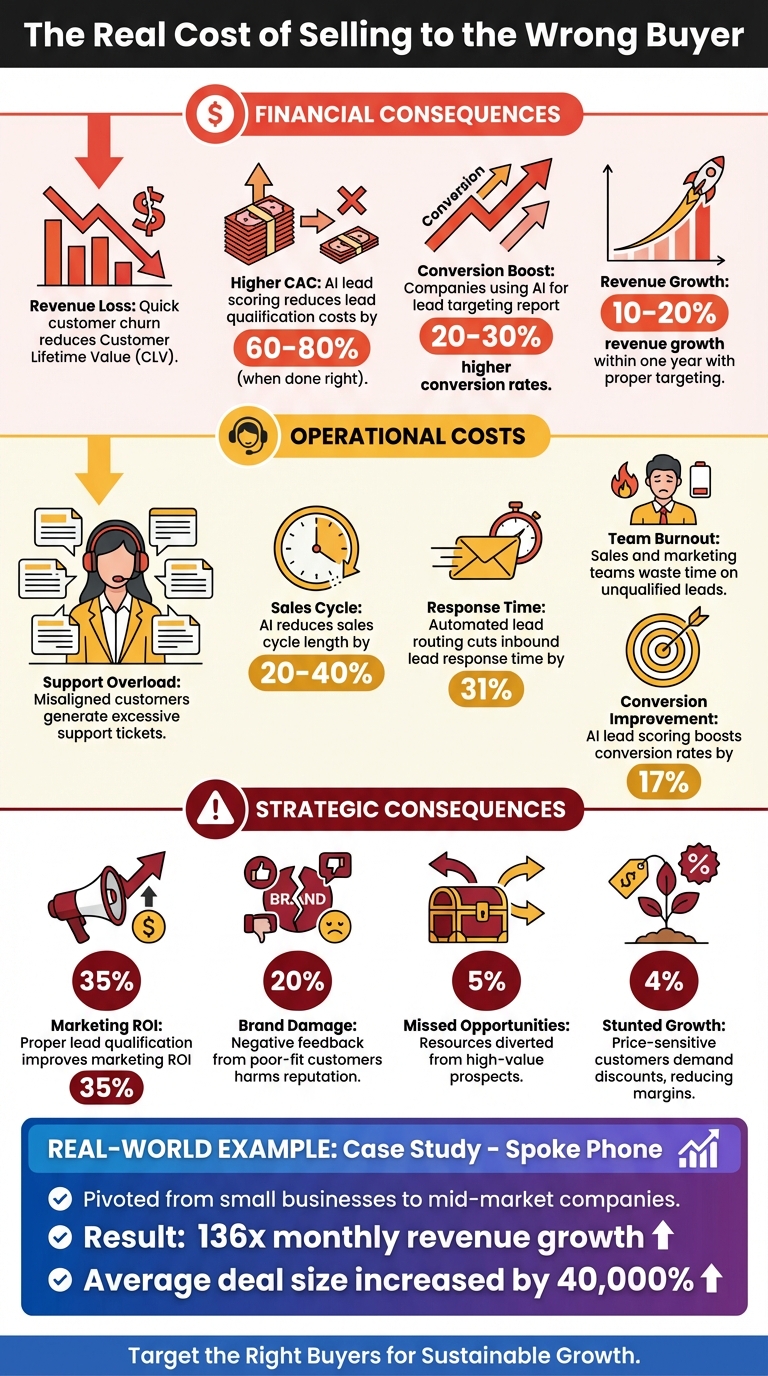
AI tools have reshaped how businesses qualify leads, reducing the risk of pursuing the wrong prospects and ensuring alignment with your Ideal Customer Profile (ICP). These tools streamline the process by analyzing behavioral data, predicting buying intent, and ranking prospects automatically based on how well they fit your ICP. The results speak for themselves: companies using AI for lead scoring and targeting report 20–30% higher conversion rates and 10–20% revenue growth within a year, all while slashing lead qualification costs by 60–80% [18]. By relying on these tools, businesses can avoid wasting resources on poorly matched leads.
Predicting Buyer Intent with AI
AI-powered intent detection dives deeper than tracking website visits. These platforms monitor prospect behavior across multiple channels - like social media interactions, content downloads, search activity, and third-party data sources - to identify when someone is actively exploring solutions that match yours [13]. Machine learning algorithms analyze these behaviors to pinpoint genuine buying interest, giving your team the ability to engage prospects at the perfect moment.
By 2025, intent platforms are expected to merge first-party data (from sources like your website and CRM) with third-party signals (such as industry research and review sites) to deliver a comprehensive view of buyer readiness [13]. They can send real-time alerts when high-value prospects show strong intent, enabling timely follow-ups. This level of precision significantly enhances the effectiveness of lead scoring systems.
AI-Based Lead Scoring Systems
AI-driven lead scoring systems use advanced techniques like ensemble methods, deep learning, and natural language processing (NLP) to predict which leads are most likely to convert [18]. These platforms integrate seamlessly with CRMs like Salesforce, HubSpot, or LeadSquared, pulling data from marketing tools, website analytics, and customer interactions to create detailed lead profiles [14][16][18].
What makes AI scoring stand out is its continuous learning capability. These systems adapt and improve based on new data and feedback from sales teams, boosting lead conversion rates by 17% [17]. They also support negative scoring, filtering out leads that are unlikely to convert - such as job seekers or competitors - saving your team valuable time [15][20].
For added transparency, look for platforms offering explainable AI, which breaks down the factors behind each lead’s score. This clarity helps your team understand what drives lead quality [14][17]. Plus, real-time scoring updates ensure that sales reps can focus on high-priority leads when it matters most [14][18][19].
Improving Sales and Marketing Coordination
Accurate lead qualification through AI doesn’t just benefit sales - it bridges the gap between sales and marketing teams. AI lead scoring provides an objective framework for evaluating lead quality, ensuring both teams are on the same page. Marketing can pinpoint which campaigns generate high-quality leads, often improving ROI by 35% [18], while sales can prioritize the leads that demand immediate attention.
The move toward Marketing Qualified Accounts (MQAs) - which emphasizes account-level signals and broader buying patterns - helps teams target the most promising customers [14]. AI systems can also automate lead routing, assigning qualified leads to the right sales reps and triggering personalized nurture campaigns based on score thresholds [16][20]. This automation reduces the time needed to respond to inbound leads by 31% and shortens sales cycles by 20–40% [15][18]. By continuously validating and enriching lead data, AI-powered systems ensure that sales and marketing teams stay aligned and productive [16].
Case Studies: Real Costs of Buyer Mismatches
When businesses target the wrong customers, the consequences can ripple through every aspect of their operations. From lost revenue to overwhelmed support teams, these real-world examples show just how costly misaligned customer targeting can be - and how correcting it can lead to dramatic improvements.
Case Study 1: Revenue Loss from High Churn Rates
HubSpot experienced a significant churn issue even as its revenue run rate climbed from $300,000 to $3 million. The problem? One salesperson reported a churn rate of 35% in a single month, compared to just 7% for another. The root cause was clear: the sales team was bringing in customers who weren’t a good fit for the product, leading to dissatisfaction and cancellations.
To fix this, HubSpot revamped its approach. They introduced better sales training and overhauled their compensation plan. Sales reps would only receive their full commission if the customers they brought in stayed churn-free for an entire year. This change not only reduced churn but also ensured a higher quality of customers [1].
While HubSpot’s example focuses on the financial toll of churn, Spoke Phone’s story highlights the operational challenges of attracting the wrong customers.
Case Study 2: Support Team Overload from Wrong Customers
Spoke Phone initially targeted small businesses for its phone systems. However, these customers quickly outgrew the platform, overwhelming the support team with requests for features the product wasn’t designed to offer.
The pandemic prompted a strategic pivot. Spoke Phone shifted its focus to mid-market companies, a better match for its product. The results were staggering: monthly revenue grew by 136 times, and the average deal size skyrocketed by 40,000%. This shift not only boosted revenue but also eased the support team’s workload, as they were now assisting customers whose needs aligned with the platform’s capabilities [1].
Building Better Sales Strategies for Long-Term Results
When it comes to creating effective sales strategies, the goal isn’t just about bringing in more customers - it's about attracting the right customers. These are the ones who align with your product’s value and are likely to stick around. By focusing on this alignment, you can build a foundation for long-term success.
Testing Your ICP with Customer Interviews
Your ideal customer profile (ICP) isn’t something you create once and forget. It needs to be tested and refined over time. A good way to validate your ICP is by conducting interviews with churned customers. These conversations can help you figure out whether they left due to a mismatch or because your product didn’t meet their expectations. Misaligned customers show you who to avoid, while feedback from dissatisfied but well-matched customers can highlight areas for improvement.
Steli Efti, CEO of Close.io, emphasizes this point:
"Important note: Sometimes, unhappy customers can actually be good-fit customers. If they are the kind of customer you want to focus on and they aren't happy with the way your product helps them accomplish their objectives, that is incredibly valuable feedback to take in and should be weighed much heavier than complaints from companies you don't want to focus on" [3].
Take the example of Heyo, a social media campaign platform. They dug into their high churn rates and discovered their ideal customers were businesses with large, engaged Facebook audiences. By tweaking their demo presentations to target this specific group, they saw better results. While some prospects walked away, those who stayed were more confident in their decision [1].
To refine your ICP even further, encourage your sales and customer success teams to collaborate. By comparing buyer personas with profiles of successful customers, you can zero in on your core audience [1]. Once you’ve gathered this feedback, the next step is to use data-driven tools to segment and prioritize leads.
Using AI to Segment and Prioritize Leads
AI has changed the game when it comes to evaluating leads. Instead of relying on manual processes or fixed scoring systems, AI leverages data from your CRM, social media, and web activity to identify patterns that signal lead quality. These tools use machine learning to analyze prospects in real time, eliminating human bias and helping you focus on leads with the highest potential [21][22][23][24].
What sets AI-driven lead scoring apart is its ability to adapt. As your business gathers more data, these systems refine their predictions. They can pick up on behavioral signals - like which pages a prospect visits, how much time they spend engaging with your content, or their company’s growth trends - that indicate strong buying intent. This allows your sales team to spend less time chasing unqualified leads and more time building relationships with prospects who are likely to convert and stick around.
With leads prioritized, the next step is to fine-tune your sales channels and messaging.
Adjusting Sales Channels and Messaging
Even with a well-defined ICP and high-quality leads, your sales efforts can fall short if your messaging doesn’t resonate or you’re using the wrong channels to reach potential customers. Your sales messaging needs to address customer pain points directly, offering clear, tailored solutions [25].
Different customer segments engage through different channels. Some prefer direct outreach via email or LinkedIn, while others lean toward self-service options or educational content. A one-size-fits-all approach no longer works [26][27].
This is where educating your sales team becomes critical. They need to know not only what makes a good customer but also what makes a bad one. For instance, Close.io avoided selling to companies with large field sales forces until 2023 because their product was built for inside sales teams. However, when good-fit prospects - like companies with large teams making numerous calls - requested features outside Close.io’s core offerings, they would challenge these customers. They demonstrated how their Predictive Dialer could double productivity, aligning the product’s strengths with the customer’s needs [3].
As Lincoln Murphy explains:
"If a salesperson has not been explicitly told the characteristics of a bad fit customer, why they're a bad fit, and what the negative consequences of doing business with that customer are, the fact that there is a possibility they might not be a great fit isn't reason enough for the salesperson to give up that sale, miss their numbers, and take home less pay" [1].
When your team understands the long-term risks of bringing in the wrong customers, they’ll be more willing to walk away from deals that don’t align with your business goals. This shift in mindset can make all the difference in building a sales strategy that prioritizes lasting success.
Conclusion: Targeting the Right Buyers for Growth
Choosing the wrong customers can be a costly mistake. It leads to higher churn rates, inflated customer acquisition costs, overburdened support teams, and a weakened brand image. When your product doesn’t align with the needs of your audience, growth becomes an uphill battle. The solution? Focus on attracting customers who truly align with your product's strengths and value.
Start by fine-tuning your ideal customer profile (ICP). This isn’t a one-and-done task - it’s a continuous process. Use customer feedback, including insights from those who’ve churned, to keep your ICP relevant and in sync with market demands.
AI tools can make this process easier. With AI-driven lead scoring and qualification, you can identify and prioritize the prospects most likely to benefit from your product.
As highlighted earlier, refining your ICP and integrating AI tools are game-changers. When you target the right buyers, everything improves. Customer lifetime value increases, acquisition costs decrease, and your team feels more motivated working with customers who genuinely benefit from and appreciate your product. Plus, the feedback you receive becomes more actionable, driving better product improvements. This strategy builds a foundation for predictable revenue and long-term success.
When you focus on customers who truly fit, every part of your business - from revenue to team morale - gets a boost. Companies that excel in targeting the right buyers don’t just survive - they thrive.
FAQs
How can I tell if I’m targeting the wrong customers in SaaS or AI businesses?
Selling to the wrong customers in SaaS or AI often reveals itself through a disconnect between what your product offers and what the customer actually needs. You might notice signs like low engagement, features sitting unused, or constant requests for functionality that falls outside your core focus. Customers who churn quickly or share frustration about the product not meeting their expectations are also red flags.
To prevent this, keep a close eye on user behavior - track how they interact with your features and pay attention to their feedback. By aligning your sales efforts with a well-defined ideal customer profile, you can minimize churn, save time and resources, and ensure your product consistently delivers value to the right audience.
What are the key elements of an Ideal Customer Profile (ICP), and how can you improve it?
An Ideal Customer Profile (ICP) outlines the key traits of customers who are most likely to benefit from what you offer. It typically includes details like demographics, firmographics, pain points, needs, and buying behaviors. These factors work together to paint a clear picture of your most promising audience.
To fine-tune your ICP, dig into patterns from your strongest customer relationships. Review feedback, examine support interactions, and identify shared characteristics that lead to successful outcomes. This insight helps you refine your targeting and lead qualification, ensuring your sales team focuses on the people who are the best fit for your product or service.
How can AI tools help sales teams find and focus on the right buyers?
AI tools are transforming lead qualification by sifting through massive datasets to pinpoint the most promising prospects. They evaluate leads using criteria such as behavior patterns, demographic details, and company attributes, allowing sales teams to focus on opportunities with the highest potential.
Beyond that, these tools make personalized outreach easier by building comprehensive customer profiles and delivering real-time insights. By simplifying the qualification process, AI ensures sales teams direct their efforts toward the right audience, cutting down wasted resources and boosting overall ROI.