Buying a business is often smarter than starting one from scratch. Here's why: acquiring a proven SaaS or AI business means skipping the risky early years, leveraging existing revenue streams, and starting with immediate cash flow. In 2025, over 12 million businesses, worth $10 trillion, were up for grabs, thanks to retiring baby boomers - most without exit plans. SaaS and AI companies stand out with predictable recurring revenue, scalability, and strong customer retention.
Key takeaways:
- SaaS/AI businesses: High Net Revenue Retention (NRR) and low churn rates make them attractive.
- Valuations: Multiples are stabilizing, with smaller SaaS companies averaging 2.85x ARR.
- Financing: SBA 7(a) loans require as little as 5–10% down, making acquisition accessible.
- Metrics to watch: ARR, churn, and customer concentration risks are critical for evaluation.
- Deal structures: Seller financing, earnouts, and escrow holdbacks reduce buyer risks.
Acquisition isn't just buying a business - it's buying time, stability, and growth potential. With the right strategy, you can start earning from day one while avoiding the pitfalls of a startup.
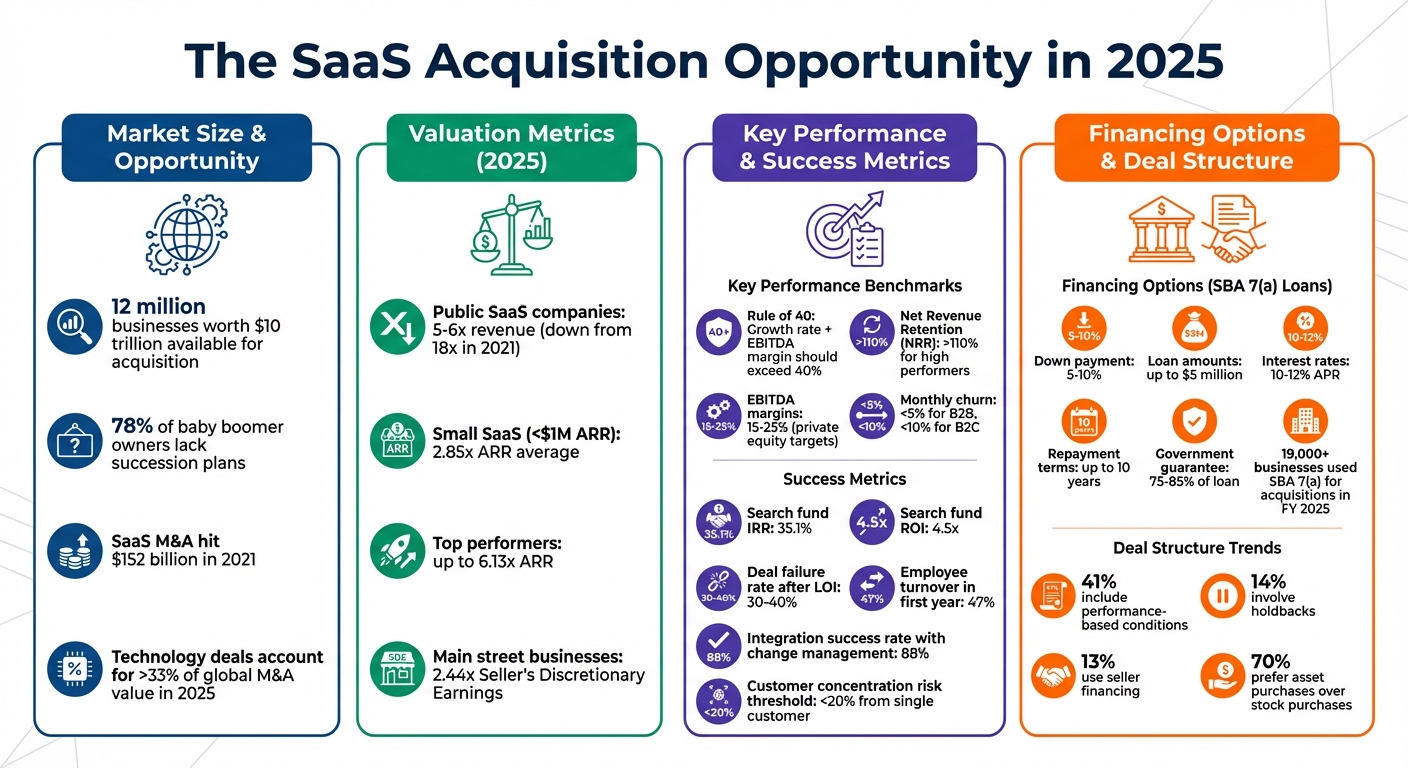
SaaS Business Acquisition Market Statistics and Financing Options 2025
The SaaS and AI Acquisition Market in 2025
Why SaaS and AI Companies Make Good Acquisition Targets
SaaS and AI companies bring a unique edge to the table: predictable, recurring revenue. Thanks to subscription-based models - whether monthly or annual - these businesses can forecast cash flow with much greater precision compared to traditional one-time sales approaches. High-performing companies often maintain a Net Revenue Retention (NRR) above 110%, meaning their existing customers spend more over time [4].
Another advantage is scalability. Modern cloud-native architectures allow these businesses to grow efficiently. Once the software is developed, supporting 10,000 users versus 1,000 doesn’t require a proportional increase in infrastructure or staff. This scalability explains why SaaS mergers and acquisitions (M&A) hit a record $152 billion in 2021 [3], and why private equity firms continue to focus on targets with EBITDA margins of 15–25% [4].
However, not all AI companies are created equal. Buyers are now more discerning, looking beyond flashy marketing to identify genuine competitive advantages. Businesses with proprietary models or unique datasets command higher valuations. On the flip side, companies that merely wrap third-party APIs in polished interfaces are facing tougher scrutiny and lower multiples [4].
Specialization is becoming a key differentiator. AI and SaaS solutions tailored to specific industries - such as healthcare compliance, legal document automation, or logistics optimization - are particularly attractive. These vertical-specific tools integrate deeply into workflows, making them harder to replace. With churn rates often below 5% for top performers [4], these companies offer the kind of defensibility buyers value highly.
These factors set SaaS and AI companies apart, positioning them well for the trends shaping the acquisition market in 2025.
2025 Market Trends Creating Acquisition Opportunities
The days of prioritizing growth at all costs are behind us. Buyers are now focused on the Rule of 40: the combined total of a company’s revenue growth rate and EBITDA margin should exceed 40% [4]. For example, a business growing 25% annually with 20% margins meets this benchmark. This shift toward balanced, efficient growth has opened opportunities for well-managed, profitable companies that might have been overlooked during the hypergrowth craze of 2021.
Valuations have also stabilized. Public SaaS companies that once traded at 18x revenue in 2021 are now valued closer to 5–6x [5]. For smaller, bootstrapped businesses with under $1 million in Annual Recurring Revenue (ARR), profit multiples average around 2.85x. However, top-quartile performers with low churn can achieve multiples as high as 6.13x [5]. This normalization creates a more accessible market, free from the intense bidding wars of recent years.
Creative deal structures are becoming the norm in 2025. To navigate market volatility, 14% of deals now include holdbacks, 13% involve seller financing, and 41% feature performance-based conditions [6]. These mechanisms help bridge valuation gaps and safeguard buyers, especially when dealing with AI businesses that may have hidden risks like technical debt or API dependencies.
Technology deals continue to dominate the M&A space, accounting for over one-third of global M&A value in early 2025 [5]. Lower interest rates have made acquisition financing easier, while strategic buyers are snapping up AI startups to address product gaps or acquire specialized talent. For those looking to transition from operators to owners, this active market presents both challenges and opportunities. The key lies in identifying the right targets and structuring deals that align with today’s market dynamics.
sbb-itb-9cd970b
How to Find and Evaluate Acquisition Targets
Where to Find Businesses for Sale
If you're looking to acquire a business, there are several platforms tailored to different needs:
- Acquire.com: Known as a leader in SaaS and AI acquisitions, this platform boasts over 1,000 vetted listings and a community of 500,000+ entrepreneurs [8][12]. Since its launch in 2019, it has facilitated more than 2,000 startup sales, totaling over $500 million [8][12]. With a rigorous vetting process, only 45% of startup applicants make it through [12]. Buyers can opt for "Premium" or "Platinum" plans, which provide access to full listings, direct communication with founders, and tools like Letters of Intent (LOI) and Asset Purchase Agreements (APA) [12].
- GetAcquired: This platform stands out by charging zero fees to buyers or sellers [7]. It integrates with FirstOfficer to verify revenue data directly from providers like Stripe, ensuring transparency for buyers.
- CounterX: Specializing in digital asset transactions, CounterX offers institutional-grade infrastructure with over $180 million in listed volume and 2,400+ verified buyers [10]. Listings include standardized metrics like Monthly Recurring Revenue (MRR), churn, Customer Acquisition Cost (CAC), and Lifetime Value (LTV), making comparisons straightforward.
- BusinessFinder: Focusing on verified online businesses, this platform reports a 98% success rate for closed deals, with an average sale time of just 45 days [9].
Before diving into any platform, clarify your criteria: your budget, the type of business model you prefer (SaaS, AI, or agency), and how much risk you're willing to take, especially with factors like customer concentration [11]. To view detailed financials and contact sellers, secure NDA access [9][12]. In today’s market, delays in communication can stall deals, so aim to respond to founders within 24 hours to keep things moving [12].
Once you've identified potential platforms, shift your focus to evaluating the health of the businesses you're considering.
Key Metrics to Evaluate Business Health
When assessing a business, start by digging into its revenue fundamentals like Annual Recurring Revenue (ARR) and Monthly Recurring Revenue (MRR). In 2025, SaaS valuation multiples typically range from 2.5x to 6x ARR [13]. For example:
- Userflow, a no-code onboarding SaaS with $4.6 million in ARR, sold for over $60 million - an impressive 13x ARR multiple [13].
- On the other hand, Predictology, a sports prediction SaaS generating $445,000 annually, sold for $720,000, reflecting a lower 1.6x multiple [13].
Metrics like Net Retention Rate (NRR) are also key. An NRR above 100% shows that customers are spending more over time, while a monthly churn rate below 5% is ideal for B2B businesses. Be cautious if a single customer accounts for more than 10% of total revenue, as this can indicate high concentration risk [13]. Always verify these figures by accessing payment processors like Stripe to cross-check payouts and watch for warning signs like seller self-subscriptions [2].
For AI-based businesses, look at Inference Unit Economics, which measure gross margins after factoring in token or API costs. In 2025, buyers heavily discount AI tools relying solely on basic foundation model APIs, sometimes by as much as 70% [13]. Additionally, a dispute rate exceeding 0.5% on payment processors is a clear warning sign [2].
"When interest rates are high, debt is expensive, and acquisition multiples compress. Right now, in 2025, we're in a compressed multiple environment."
Beyond financial metrics, review 6 to 12 months of support tickets to uncover recurring product issues. If possible, request GitHub access to evaluate documentation, automated tests, and any outdated dependencies that could lead to security vulnerabilities [2].
Determining Fit and Growth Potential
Once you've analyzed financial health, consider how well the business aligns with your skills and its potential for growth.
Start with a "Buy vs. Build" test. If the software could be rebuilt for minimal cost (e.g., $500 in AI coding credits), it’s likely a commodity. Without a strong community or unique distribution channels, such software should be priced accordingly [2].
"Code is not a moat. Code is a commodity. What matters is community, distribution, and hard-to-get certifications."
- Alex Boyd, Founder, Wildfront [2]
Think about whether your strengths align with the business's operational needs. For example, if you're skilled in sales and marketing but the business requires heavy technical upkeep, you might need to hire or partner with skilled developers. Non-technical buyers should ensure the codebase is well-documented and easy to maintain [2]. Also, realistically assess how much time you can dedicate to running the business - some may require significant hands-on involvement [14].
Before making an offer, look for three critical "moats" that protect the business from competitors: a loyal community, strong distribution (like excellent SEO or brand recognition), and certifications that are hard to obtain, such as HIPAA or SOC 2 compliance [2]. For instance, in early 2026, Wildfront acquired inlytics.io despite issues like outdated tech and declining MRR. Why? The asset offered transferable SEO, over $2,000 in MRR, and an enterprise email list that perfectly suited their needs [2].
For AI businesses, check for over-reliance on a single API provider (e.g., OpenAI) and ensure profit margins remain healthy as usage scales [2]. Spend 30 to 60 days shadowing the founder to fully understand workflows, from sales to customer support, before making significant changes [15].
Deal Structure and Financing Methods
Common Deal Structures Explained
When structuring a deal, clarity and risk management should be at the forefront. The simplest option is an all-cash deal, where the buyer pays the full amount upfront. This approach gives the seller immediate liquidity and a clean exit, but it places all the financial risk on the buyer [16][21].
More often, deals involve seller financing, where the seller loans a portion of the purchase price - typically between 25% and 75% - to the buyer. This amount is repaid over time with interest. Seller financing can help bridge valuation gaps and signals the seller’s confidence in the business's future [16][17].
Another option is earnouts, which tie part of the payment to the business’s future performance. For example, payments may depend on hitting specific revenue milestones. Earnouts can help satisfy the seller’s pricing expectations but should ideally last no longer than 6–12 months to avoid disputes over performance metrics [17][21][16].
For many small-to-mid-market transactions, asset purchases are common. Buyers can choose specific assets while using an escrow holdback - typically 5–15% of the purchase price held for 12–24 months - to mitigate risks like undisclosed liabilities [17][18].
"The purchase agreement is the single most consequential document in any business deal. It determines what transfers, what liabilities follow, how taxes are allocated, and what happens when something goes wrong after closing."
- Alex Lubyansky, Esq., Managing Partner, Acquisition Stars [18]
Your choice of deal structure directly impacts your financing options, so it’s essential to align the two.
How to Finance Your Acquisition
For individual buyers, an SBA 7(a) loan is often the most practical financing tool. These loans are backed by government guarantees covering 75–85% of the loan amount, making them attractive to lenders. In fiscal year 2025, over 19,000 businesses used SBA 7(a) loans for acquisitions [23][22]. Loan amounts can reach up to $5 million, typically requiring a 10% down payment. This can drop to 5% if the seller provides a standby note for the other 5%. Interest rates generally range from 10–12% APR, with repayment terms extending up to 10 years [22][23].
To speed up the process, work with SBA Preferred Lenders, who can streamline approvals. Be prepared to budget an extra 5–10% of the purchase price for additional costs such as:
- Business valuations: $1,500–$2,500
- Quality of Earnings reports: $5,000–$15,000
- Legal fees: $5,000–$15,000 [22]
If you’re looking for faster financing, private credit is another option. With global assets under management exceeding $3 trillion, private lenders can close deals in weeks instead of months. However, this speed often comes with higher interest rates. In 2024, private debt firms financed about 77% of global leveraged buyouts [19][20].
For buyers considering conventional bank loans without SBA backing, expect stricter requirements. These loans often demand a 20–30% down payment and shorter repayment terms of 5–7 years [23]. To avoid delays during the 30–60 day due diligence period, it’s smart to finalize your financing strategy before signing a Letter of Intent [23].
Once financing is secured, focus on negotiating terms that align with your goals.
Negotiation Strategies That Work
Begin by determining your BATNA (Best Alternative to a Negotiated Agreement) - your fallback plan if the deal doesn’t go through. Having a clear walkaway point strengthens your position. A well-known example is Microsoft’s decision to walk away from a $47.5 billion offer for Yahoo in 2008, showcasing the power of a strong BATNA [24].
Use calibrated questions to uncover the seller’s priorities. For example, ask, “How would you ideally see this deal structured?” or “What concerns you most about the transition?” Pair these with empathy-driven statements like, “It seems like you’re frustrated with the timeline.” This approach builds rapport and can reveal hidden constraints [24].
Presenting multiple equivalent simultaneous offers (MESOs) is another effective tactic. For instance, you could offer one package with higher upfront cash and a shorter earnout, and another with less cash but a longer earnout. This strategy helps clarify what the seller values most [24].
To protect yourself, consider bridging valuation gaps with earnouts or seller financing, which can shield you from potential underperformance [18][25]. Negotiating a working capital peg - a target amount of working capital at closing - prevents the seller from draining cash or speeding up collections just before the deal closes. Additionally, agreeing on how to allocate the purchase price between depreciable assets and goodwill early in the process can help avoid tax disputes later [18].
For self-funded buyers, it’s crucial to highlight your hands-on commitment to running the business. Sellers often prefer operators over investors, especially when legacy and continuity matter. As Danielle Hunt explains:
"A self-funded buyer who plans to operate the business day-to-day checks all three boxes [price, employee treatment, business continuity] in a way that a PE-backed buyer might not."
- Danielle Hunt [26]
Due Diligence and Closing Process
Financial and Operational Review
Once the deal terms are set, it's time to dive into due diligence. Start by reviewing accrual-based Profit & Loss statements from the past 24–36 months, along with balance sheets, cash flow statements, and tax returns for the last 3–5 years [27]. To ensure the business is growing as claimed, request a monthly MRR (Monthly Recurring Revenue) bridge that breaks down new revenue, expansion, churn, and contraction [27].
A key area to focus on is customer concentration risk. If more than 20% of revenue comes from a single customer, buyers often lean toward earnout-based structures to offset potential risks [27]. Be sure to examine financial schedules closely for any hidden liabilities.
On the operational side, ask for a detailed product roadmap that outlines priorities and ownership. Also, request documentation for support processes, including ticketing systems, service level agreements, and customer success playbooks for onboarding and renewals [27]. An organizational chart is essential, as it reveals roles, compensation structures, and any critical dependencies on key personnel that could disrupt operations if they leave.
"A clean MRR bridge is more valuable than a pretty deck." - Amanda White, SaaS acquisition expert [27]
For legal and technical checks, confirm that all employees and contractors have signed intellectual property (IP) assignment agreements - missing signatures can signal major issues [27][29]. Review material contracts for change-of-control clauses that might allow termination upon sale. Additionally, verify security policies, including SOC 2 audits and GDPR/CCPA compliance. A cautionary tale: Verizon discovered two massive data breaches during Yahoo's acquisition in 2017, slashing $350 million off the purchase price [28].
To keep everything organized, create a structured data room with folders for Corporate, Financials, Customers, Product, People, and Legal, along with an index document. While most SaaS acquisitions take 3–6 months to close, preparing thoroughly can take up to a year [27]. This effort ensures you're buying a business that aligns with your long-term goals.
Legal Agreements and Contract Terms
After the operational review, it's time to finalize the legal side of the deal. The Purchase Agreement (PA) is the cornerstone document that transfers ownership and formalizes protections after closing, overriding earlier discussions or the Letter of Intent [18][32].
"The purchase agreement is where deals are actually won or lost. Everything before it was preamble." - Alex Lubyansky, Esq., Managing Partner, Acquisition Stars [18]
Decide whether to structure the deal as an asset purchase or a stock purchase. Most buyers - about 70% - favor asset purchases due to tax advantages (like a stepped-up basis) and reduced liability risks. On the other hand, stock purchases transfer the entire legal entity, including its liabilities [18][32].
Indemnification is another critical piece. Build a robust framework that includes caps, baskets, and survival periods to handle post-closing disputes, which occur in roughly 30% of middle-market transactions. To cover potential claims, it's common to hold 10–15% of the purchase price in escrow for 18–24 months [18].
A working capital adjustment is also essential. This mechanism adjusts the purchase price based on the actual working capital delivered at closing, discouraging any last-minute financial maneuvers by the seller [18][32]. Agreeing on purchase price allocation early can also prevent future tax issues.
Hiring an M&A attorney who specializes in acquisitions is a smart move. These experts are better equipped to handle complex deal elements like tipping baskets and working capital pegs. For a $5 million deal, expect attorney fees to range between $30,000 and $75,000 - roughly 0.6–1.5% of the deal value [32].
Closing the Deal and Planning the Transition
Once due diligence and legal agreements are squared away, the focus shifts to closing and transitioning. The period from signing the LOI to closing typically takes 60–90 days and involves finalizing due diligence, securing financing, and negotiating the Purchase Agreement [31]. However, this phase is delicate - 31% of deals fall apart here, and 30–40% of signed LOIs never make it to closing [31][32].
Before the big day, verify all representations, secure any required third-party consents, and confirm financing. If you're using an SBA 7(a) loan, which can take 45–90 days to process, it's wise to have backup financing in place, such as seller-financing or a conventional loan [32].
On closing day, the schedule is typically tight. Start with a 7:00 AM walkthrough to inspect inventory and facilities, move on to document signing by 9:00 AM, and aim to complete the wire transfer by 1:00 PM [31]. Use the final walkthrough to ensure all assets align with due diligence findings.
A Transition Services Agreement (TSA) is crucial for post-closing support. It should clearly outline the seller's responsibilities, including duration, hours, and specific duties [18][31]. Without this, you risk losing vital operational knowledge. For example, Sprint's $35 billion acquisition of Nextel in 2005 led to a $30 billion write-down due to poor post-closing integration [32].
Finally, plan an all-hands meeting with employees as soon as the wire transfer clears. This helps stabilize the workforce and communicate your vision. Companies with strong change-management strategies achieve an 88% success rate in meeting project goals, compared to just 13% for those without such practices [14].
Growing the Business After Acquisition
Integrating the Acquired Business
The first 90 days after acquiring a business are critical. This period lays the groundwork for long-term success by focusing on stability rather than immediate changes. Employee turnover can hit 47% in the first year, so your goal should be to steady the ship before making big moves [34]. A phased approach works best: Stabilize (Months 1-3), Optimize (Months 4-12), and Scale (Year 2+). Jumping into growth too soon often amplifies existing issues instead of resolving them.
"Stabilize before you optimize. Optimize before you scale." - Team Acquira [35]
A useful tool is the "Learn, Plan, Start" Framework, especially for the first 100 days. Spend the first month observing and gathering feedback from your team. Use the second month to create a focused plan based on your findings. Then, in the third month, begin implementing gradual changes. This deliberate process helps build trust, which is crucial since employees typically need three payroll cycles to feel confident in new ownership [36]. Keep the current payroll system unchanged for at least 90 days to avoid mistakes that could damage morale.
Early stabilization efforts should prioritize addressing small but impactful issues and retaining key middle managers. These managers often hold vital institutional knowledge and are at the highest risk of leaving. For example, Disney’s acquisition of Pixar succeeded partly because Disney preserved Pixar’s creative culture and leadership while integrating back-office operations [33]. On the flip side, poor integrations can drop client retention rates below 80%, while well-managed ones maintain rates between 85-95% [34].
Quick wins can create goodwill among employees and clients. Fix 2-3 low-cost, high-visibility issues - like broken equipment or outdated software - within the first week. For top clients, make personal calls on the day of the acquisition announcement and schedule regular check-ins during the first year. Also, document critical knowledge from employees before they leave.
Expect a "J-curve" in EBITDA, with a temporary dip of 10-20% during the first six months as you professionalize systems like accounting, HR, and software [36]. This is normal and part of the process. For instance, Dell-EMC achieved $1.7 billion in cost savings during its first year by following a disciplined integration strategy [33]. Typically, you’ll see recovery to baseline performance between months 7-18, with stronger growth by Year 2 or 3.
Once operations are stable, you can shift focus to leveraging technology to drive growth.
Using AI and SaaS Tools to Scale
After stabilizing your team, technology becomes a major lever for growth. In 2025, 45% of M&A executives reported using AI tools, more than doubling from the prior year [30]. The focus should be on tools that directly impact revenue and customer retention instead of chasing every new platform.
One key area is churn management. Cutting monthly churn from 10% to 5% doubles Lifetime Value (LTV) [2]. Tools like ChurnZap can identify at-risk customers and automate retention efforts. Analytics platforms such as Mixpanel, Amplitude, or PostHog should be implemented within the first 30 days to analyze user behavior before making significant changes [2]. AI can also review past support tickets to uncover recurring issues that can be addressed with automation or product updates.
Pricing strategies offer another big opportunity. A/B testing pricing models has been shown to boost revenue by 12-40% annually [3]. Introducing annual prepaid plans as the default option can improve both cash flow and customer commitment. Automating onboarding processes, such as using tooltips, guides, and welcome emails, can also lift trial-to-paid conversion rates - personalized calls-to-action alone can increase conversions by 42% [37].
"The code itself? Worth almost nothing in the AI era. The hard-to-replicate stuff around it? That's where the value is." - Alex Boyd, Wildfront [2]
For AI-driven SaaS businesses, keep a close eye on Inference Unit Economics to ensure operational costs, like token and tool usage, don’t outpace revenue [2]. Diversify beyond a single AI model vendor, such as OpenAI, to avoid margin risks from potential price hikes. Instead, focus on building irreplaceable assets like customer loyalty, strong distribution channels (e.g., SEO and email lists), and regulatory certifications like HIPAA or SOC 2.
If you’re managing multiple businesses, standardize back-office operations and adopt shared technology platforms across your portfolio. This approach can unlock cost efficiencies and drive higher valuation multiples - SaaS roll-ups often achieve 3-5x higher valuations compared to individual solutions [3]. A structured acquisition strategy consistently outperforms organic growth [25].
Tracking Performance and Planning Your Exit
As you scale, tracking performance metrics becomes essential, especially if you’re planning an eventual exit. Keep a close eye on EBITDA trends, gross margins by service line, and working capital cycles to spot cash flow bottlenecks [35][14]. For SaaS businesses, Net Revenue Retention (NRR) above 100% signals that customers are spending more over time, demonstrating strong product-market fit and pricing power [3]. Compare Customer Acquisition Cost (CAC) to LTV - if CAC rises disproportionately as you scale, your growth isn’t sustainable.
Operational efficiency is another key indicator. Revenue per employee can reveal how well the business is functioning as you prepare for a sale [35]. Ensure no single customer accounts for more than 20% of total revenue to reduce concentration risk [2]. For AI and SaaS companies, monitor dispute rates (aim for below 0.5%), refund rates, and churn. B2B SaaS businesses should target churn below 5%, while B2C businesses should aim for less than 10% [2].
Using a weekly scorecard to monitor key metrics like employee morale, cash flow, and customer satisfaction can help you stay on track from day one [35]. Analyzing churn by cohort (based on when customers joined) can reveal whether quality is slipping as the business grows. Research shows that organizations with strong change-management practices achieve an 88% success rate in meeting their goals, compared to just 13% for those with weak practices [14].
"Real scaling means growing revenue and profit without proportionally increasing your time, stress, or resources." - Team Acquira [35]
Exit planning should begin the moment you acquire the business. Maintain clean financial records, document all processes, and build systems that can operate without your direct involvement. Buyers will look at the same metrics you analyzed during acquisition: MRR growth, churn rates, customer concentration, and operational dependencies. Businesses with automated systems, diversified revenue streams, and strong competitive advantages tend to command higher valuations.
In 2021, SaaS M&A deals hit a record $152 billion, and the market remains favorable for well-run businesses [3]. Whether you’re holding for five years or planning a quicker exit, treating every acquisition as if you’ll sell it tomorrow instills the discipline needed to create long-term value. By consistently tracking performance and refining operations, you align with best practices for building value over time.
21 Businesses Bought: How To Acquire A SaaS Business with Dirk Sahlmer
Conclusion
The Operator-to-Owner Playbook offers a clear and structured path to business ownership with reduced risks. By acquiring an established business, you sidestep the daunting 50% failure rate that startups face within their first five years. Instead, you tap into the strong track record of search funds, which boast a 35.1% IRR and a 4.5x ROI [1].
The timing couldn't be better. With 78% of baby boomer business owners lacking succession plans [1], a massive $14 trillion wealth transfer is underway. On top of that, SBA 7(a) loans make it possible to acquire profitable businesses with just 5–10% down [26]. This means you can start generating revenue immediately, avoiding the typical 2–3 years of losses that startups often endure.
"Acquisition gives you cash flow from day one while startups require 2–3 years of negative cash flow before you know if it works." - Danielle Hunt [26]
For those eyeing SaaS and AI businesses, the game has changed. AI has commoditized code, shifting value to assets that are much harder to replicate - like strong distribution networks, loyal customer bases, and regulatory certifications. These assets, which can take years to develop organically, can be acquired instantly. And with the median sale price for main street businesses in late 2025 sitting at about 2.44x Seller's Discretionary Earnings [26], there are plenty of opportunities for first-time buyers who approach the process with discipline.
Whether you're looking at a $900 micro-SaaS or a $5 million service company, the key is to focus on businesses with solid competitive advantages, use deal structures that preserve capital, and ensure stability before making improvements. A well-executed acquisition strategy includes building a systematic filter for identifying opportunities, verifying revenue through payment processors, and prioritizing businesses with strong Net Revenue Retention. By mastering these steps, you can create a repeatable process for acquisitions that steadily builds wealth over time.
FAQs
What’s a safe price to pay for a small SaaS in 2025?
When determining a fair price for a small SaaS business in 2025, the range usually lands between 3x to 5x Seller Discretionary Earnings (SDE) or approximately 5x to 6x revenue. These valuation multiples align with prevailing market conditions and account for the typical risks associated with such acquisitions.
How do I verify revenue and churn before I buy?
When you're considering buying a SaaS business, it's crucial to verify its revenue and churn metrics through detailed due diligence. Start by analyzing essential figures like Monthly Recurring Revenue (MRR) and Annual Recurring Revenue (ARR) to get a clear picture of the business's financial health. Dive into the churn rate and customer retention stats to understand how well the company holds onto its customers.
Take the time to review historical revenue records and growth patterns. This will help you confirm whether the business has been financially stable over time. Using templates and checklists can make this process more organized, ensuring no critical detail is overlooked before you make your final decision.
What’s the biggest risk when buying an AI tool business?
The biggest risk when buying a business is owner-dependency - a situation where the business relies too much on the current owner for its operations, revenue generation, or key decision-making. If the owner steps away for as little as 60 to 90 days, the business could face major disruptions or even fail to function altogether. This is why assessing how independent the business is from the owner is a critical step in the buying process.