Feeling stuck in your business? If you're a founder doing everything yourself, you're likely holding your company back. Transitioning from an operator to an owner is the key to scaling your business and creating long-term success. Here's the roadmap:
- Shift Your Mindset: Stop asking, "How do I do this?" and start asking, "How do I build a system for this?"
- Focus on High-Impact Work: Delegate tasks others can handle at 70% of your efficiency. Prioritize what only you can do - like setting the vision and building key relationships.
- Build Scalable Systems: Document workflows, set decision-making frameworks, and track key metrics to reduce dependency on you.
- Delegate Effectively: Create a "Stop-Doing" list, hand off responsibilities with clear guidelines, and test your systems by stepping away.
- Leverage AI and Automation: Use tools to streamline repetitive tasks, lead generation, and customer support, saving time and boosting productivity.
- Prepare for Growth or Exit: Ensure your business can run without you, focus on financial transparency, and test readiness with a "Vanish Test."
The goal? Build a business that thrives without you. Whether you're scaling or preparing to sell, this shift is essential for sustainable growth.
From Operator to Owner: The CEO Blueprint for Freedom and Scale
sbb-itb-9cd970b
Step 1: Change Your Role and Mindset
The toughest part of transitioning into an ownership role isn’t picking up new skills - it’s letting go of old habits. You’ve likely thrived by being the go-to problem solver, the deal closer, and the one with all the answers. But holding onto that identity can hold you back.
The key shift starts with a simple question. Operators think, “How do I do this?” Owners ask, “How do I create a system for this?” [2] This isn’t about working fewer hours; it’s about redirecting your focus. Instead of staying immersed in daily tasks, your role evolves into designing the systems that ensure long-term success. This mindset shift is what allows you to focus on decisions that truly move the needle.
Concentrate on High-Impact Work
If your day is consumed by tasks others could handle - even at 70% of your efficiency - you’re stuck in operator mode. High-impact work is defined by tasks that only you can do as the owner. These include setting the company’s vision, building key relationships with investors or partners, shaping the culture, and making strategic calls about product direction or market positioning. Anything outside of these priorities? Delegate it or create a system to handle it. Spending time on low-value tasks means sacrificing the unique contributions only you can make [2].
Set aside one full day every week - Wednesday is often ideal - for uninterrupted focus on strategic thinking and planning. Use this "CEO Day" for designing systems and mapping out long-term goals. Research shows that avoiding context-switching can increase productivity by up to 40% [2]. By making high-impact work your priority, you set the groundwork for scalable systems and smart delegation, which will be covered later.
Write Down Your New Responsibilities
Vague goals don’t drive change - clear commitments do. Beyond adjusting your focus, formalizing your new role makes the shift tangible. Write a concise, one-page CEO job description outlining responsibilities like defining company culture, managing investor relations, setting quarterly priorities, and mentoring senior leaders [5]. Alongside this, create a "Stop-Doing" list of tasks you currently handle that fall outside these priorities.
Sharing these documents with your team is crucial. It sets clear expectations and builds accountability. When your team knows you’re no longer approving expense reports or reviewing every marketing email, they’ll step up to take ownership of those decisions themselves.
Step 2: Create Systems That Scale
To grow your business without being tied to every decision or process, you need systems that allow for independent operation and scalable growth. With this "owner mindset", the focus shifts from personal productivity to building frameworks that make the business less dependent on you. Take Scott Fritz’s example: he scaled his professional employer organization to $170 million in revenue across 42 states by prioritizing independent systems over personal involvement [7].
Scalable systems are built on three key layers: Decision Systems, which define criteria for recurring decisions; Process Systems, which document workflows that can be repeated; and Performance Systems, which create feedback loops through metrics and reviews [7]. While a full transformation might take 12–18 months, high-frequency processes can show improvement in as little as 30–60 days [7]. Start with the areas where you’re most involved, and expand from there.
Set Up Decision-Making Frameworks
One of the quickest ways to stall growth is by being the bottleneck for every decision. As Bill Rice, Strategy Consultant, puts it:
"If you're still doing everything yourself, you're not leading - you're just surviving." [8]
To avoid this, establish decision-making frameworks that clarify who makes decisions and under what conditions. Models like RAPID (for major decisions like pricing changes), RACI (for complex, cross-functional projects), or DACI (for roadmap clarity) can help streamline the process. For instance, SyncUp, a B2B SaaS company, used DACI to eliminate indecision in their product roadmap. They assigned the Product Manager as the "Driver", the Head of Product as the "Approver", and other team leads as "Contributors", which sped up decisions for new Zapier integrations [10].
These frameworks work best with clear thresholds. For example, any decision affecting more than $10,000 in new monthly recurring revenue should follow a formal process. Similarly, product updates impacting over 25% of active users may require cross-functional alignment, while high-level hires should have documented criteria and input from multiple stakeholders [10].
For prioritization, adopt tools like the ICE Score to rank features or marketing experiments. This replaces subjective decisions with data-driven growth insights, improving decision accuracy by 35% [10]. Keep a Decision Log to document major calls, including the decision owner, rationale, and expected outcomes. This creates a record for future reference and regular reviews, ensuring decisions are informed and consistent.
Once decision-making is streamlined, focus on tracking metrics to ensure these systems are delivering results.
Track Key Metrics and Reports
Tracking the right metrics is crucial for improvement. While operators may fixate on top-line revenue, owners focus on broader metrics like margin, cash flow, unit economics, and capital efficiency [7].
Use the 3F KPI Filter to evaluate your metrics. Every metric on your dashboard should be forward-looking, friction-specific, and directly tied to an actionable fix [11].
"If a metric doesn't pass all three [Forward-Looking, Friction-Specific, Fix-Linked], it doesn't belong on your dashboard." - Kamyar Shah, Fractional COO [11]
Your key metrics should match your growth stage. For businesses with annual recurring revenue (ARR) between $1 million and $5 million, focus on metrics like Customer Acquisition Cost (CAC) by channel, payback period, win rate, and Net Revenue Retention (aiming for at least 90%). As ARR grows to $5 million–$20 million, add metrics like the Magic Number (targeting above 0.75), the CAC:LTV ratio (aiming for 3:1 or better), and the Rule of 40 (where growth rate plus profit margin equals 40% or more) [13].
To avoid overwhelming your team with data, limit your operational scorecard to 5–15 key metrics [12]. Many teams find value in reviewing these metrics weekly during structured meetings - such as a "Level 10 Meeting" - to identify and address issues early.
In addition to financial KPIs, track metrics that measure the health of your systems. These might include process consistency, how quickly new hires reach full productivity, and how often you’re pulled back into daily operations [7]. These indicators show whether your systems are truly reducing your involvement, helping you shift fully into the role of an owner rather than an operator.
Step 3: Hand Off Operations to Your Team
Did you know that 58% of founders find delegation challenging? [2] Moving from being the operator of your business to its owner requires more than just good intentions - it demands a structured plan. This plan should transfer both responsibility and authority to your team, ensuring they can manage operations without you constantly stepping in. By using the decision-making frameworks you've already established, you can delegate tasks effectively and step back from the day-to-day grind.
Build a Leadership Handoff Plan
Start by creating a "Stop-Doing" List over the course of two weeks [2][15]. This involves tracking all your tasks and categorizing them into four groups:
- Low Skill/Low Impact: Delegate these immediately.
- High Skill/Low Impact: Use these tasks to help your team grow or find ways to automate them.
- Low Skill/High Impact: Document these tasks with clear guidelines to ensure consistency.
- High Skill/High Impact: Keep these tasks for yourself - they’re where your expertise is most needed. [2][4]
"If you're a $500/hour CEO doing $50/hour tasks, you're leaving profit on the table." - Leaders Adapt [2]
Next, implement a 90-day plan to transition responsibilities:
- Weeks 1–4: Document tasks and identify quick wins for delegation.
- Weeks 5–8: Create Standard Operating Procedures (SOPs) and provide training.
- Weeks 9–12: Fully transfer ownership and test your systems by stepping away for five days ("Vanish Test") to pinpoint any gaps [2][14].
For each task you delegate, prepare a brief with three key elements:
- Outcome: Define what success looks like, including clear metrics.
- Context: Explain why the task matters to the business.
- Resources: Provide tools, templates, logins, and key contacts [6].
A well-thought-out delegation plan ensures your team is ready to operate independently.
Make Your Business Run Without You
Delegation isn’t just about offloading tasks - it’s about building a team that can function without constant oversight. To do this, establish three levels of decision-making authority:
- Level 1: Routine tasks that team members can handle on their own.
- Level 2: Tasks requiring supervisor approval.
- Level 3: Strategic decisions reserved for you as the owner [14].
When team members seek your input, ask them, "What would you do?" This encourages them to develop sound judgment and present well-considered options [14].
Delegate tasks that others can perform at 70% of your efficiency [3]. Don’t let perfectionism hold you back - it’s often just a form of control that stifles growth. Leaders who embrace delegation frameworks can reclaim an average of 60 hours per month, freeing up time for strategic planning, building partnerships, and shaping the company’s future [3].
Instead of lengthy job descriptions, use Role Scorecards. These one-page documents outline 3–5 core responsibilities and key metrics for success, offering clarity without micromanagement [2][4]. To stay on track, schedule daily, weekly, and bi-weekly check-ins for short-term tasks, ongoing operations, and long-term initiatives, respectively [4]. Additionally, tools like Asana, Jira, or ClickUp can provide automated dashboards, giving you visibility without requiring constant manual updates [4][6].
The ultimate test of your delegation efforts? Step away. As Jodie Cook wrote in Forbes:
"The business that needs you least is worth the most, to customers, buyers and to you" [14].
If your business can’t function for a week without you, it’s a sign that you haven’t fully handed off control. Instead of removing yourself from operations, you’ve become the bottleneck for approvals. It’s time to let your team take the reins.
Step 4: Use AI and Automation to Save Time
Once you've delegated tasks and set up efficient systems, it's time to supercharge your team's productivity with AI. Moving from operator to owner means leveraging technology to handle repetitive tasks. This approach can boost productivity by 40% [22] and save finance teams 30% of their time [23]. The trick is knowing which tools to use and where they’ll have the biggest impact. Let’s dive into how AI can drive both revenue growth and operational efficiency.
Apply AI for Lead Generation and Sales
AI can completely change how you find and engage prospects - without needing to grow your team. For example, Clay pulls data from over 75 sources, gathering company details, contact info, and behavioral signals automatically. Meanwhile, Salesforce Einstein uses historical data to predict lead scores, helping your team focus on the leads most likely to convert [22].
In December 2025, Popl, a digital business card platform, used Zapier and OpenAI to streamline lead routing from HubSpot forms to Slack and their CRM. By adding AI to filter spam and prioritize inbound emails, they saved $20,000 annually across more than 100 workflows [17]. Around the same period, ActiveCampaign implemented an AI-powered onboarding system using Zapier and Demio. This system automatically tagged new signups by language and enrolled them in tailored webinars, leading to a 440% increase in webinar attendance and a 15% drop in early churn within 90 days [17].
A good starting point is the "Revenue First" rule: focus on automations that protect or generate revenue before tackling time-saving tasks [16]. Build AI workflows that capture leads, score engagement, and trigger personalized follow-ups. Tools like Zapier Agents and Lindy act like virtual teammates, handling tasks like web research, email management, and CRM updates without constant input [18][20]. These systems ensure your sales processes run around the clock, even when your team is offline.
Automate Repetitive Tasks
To get the most out of automation, focus on entire workflows instead of single tasks. Repetitive work like email triage, meeting scheduling, data entry, and customer support can drain your team's energy. AI-powered tools like Zapier, Make, n8n, and Gumloop connect your SaaS apps and make decisions (like classifying lead intent) instead of relying on rigid if-then rules [17][19].
Take Remote, a global HR platform, as an example. With only three team members managing 1,100 monthly support tickets for 1,800 employees, they created an AI-powered help desk using Zapier, Okta, and ChatGPT. This system classified issues and suggested solutions based on past tickets, automatically resolving 28% of requests and saving over 600 hours each month [17]. AI-enhanced support systems can also handle up to 60% of tier-1 inquiries, allowing teams to maintain a rep-to-customer ratio of 1:1000 [21].
For communication, tools like Superhuman Mail and Shortwave use AI for email triage, summarization, and instant drafting [22][23]. Meanwhile, Reclaim.ai and Motion automate time-blocking and meeting coordination, ensuring your calendar aligns with your priorities [22]. Nicole Replogle from Zapier sums it up well:
"AI workflow automation is basically automation with a brain. You can delegate the parts of your work that are repetitive (but still complex) to software that can actually interpret context instead of just following rigid rules" [17].
To decide what to automate first, use a prioritization matrix: focus on Revenue Protection (like onboarding and follow-ups), Time Return (such as email triage or meeting notes), and Interesting/Complex Tasks [16]. Set confidence thresholds (e.g., 95% certainty for spam detection) so workflows proceed automatically only when reliability is high. Lower-confidence tasks can be routed to a human for review [24]. The goal isn’t to replace humans - it’s to free them from tedious tasks like research and data gathering, so they can focus on decisions, strategy, and nuanced judgment calls [24]. With AI handling the routine, you stay in control while your systems do the heavy lifting.
Step 5: Get Ready for Growth and Exit
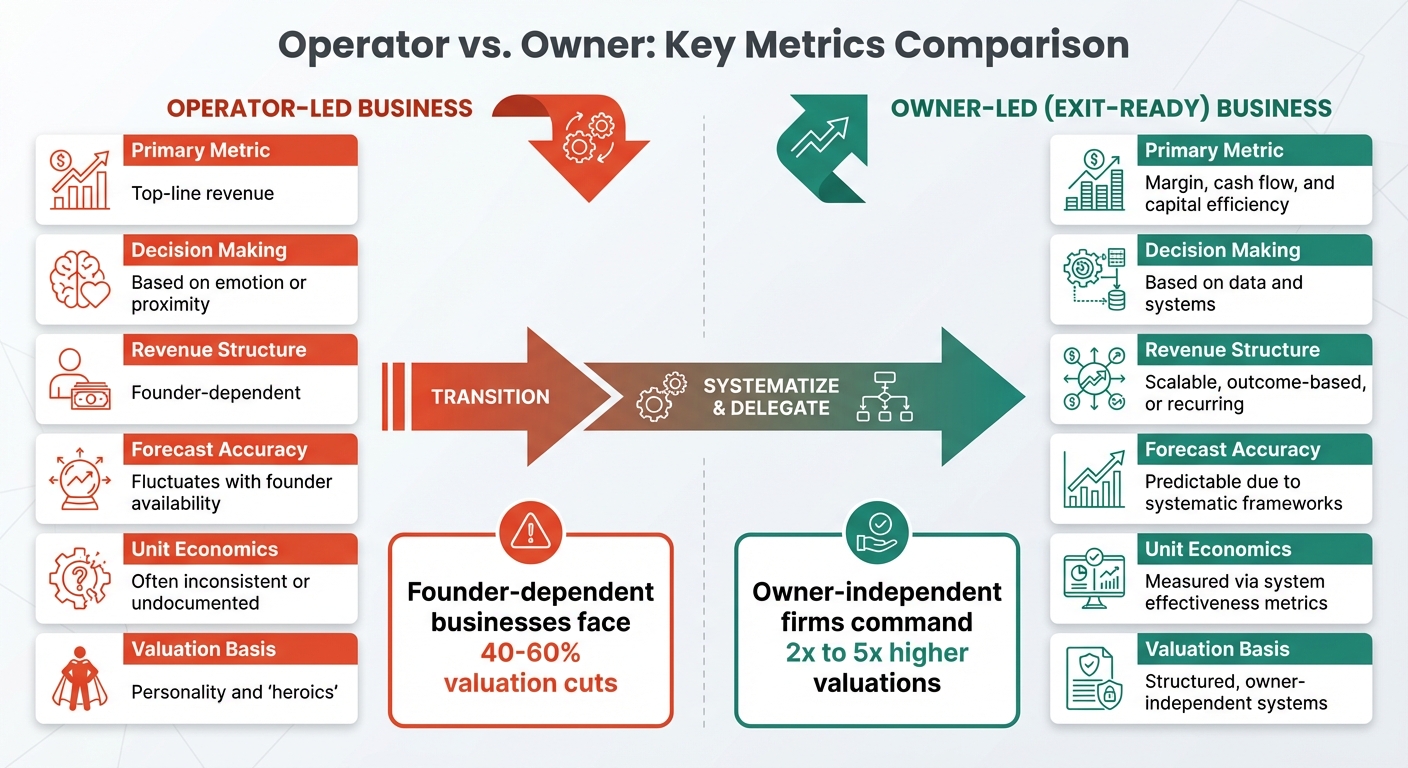
Operator vs Owner Business Model Comparison
Once you've automated and decentralized your operations, the next step is to turn your business into an asset that buyers and strategic acquirers find irresistible. This isn't solely about preparing to sell - it's about creating a company that can thrive without your constant involvement. Businesses that rely heavily on their founders often face valuation cuts of 40% to 60%, while those with streamlined operations and delegated responsibilities are far more attractive to buyers [25]. Strategic acquirers prioritize predictable systems over founder-dependent expertise, making this transition critical.
Fix Your Financials and Reporting
If you're aiming for a smooth exit, financial transparency is non-negotiable. While operators may obsess over revenue growth, potential buyers care more about profit margins, cash flow, and capital efficiency [1]. To signal stability, aim for at least 60% of your revenue to be recurring or predictable [26]. Document your financial workflows to eliminate bottlenecks, and implement dashboards that track cash flow, customer satisfaction, and productivity metrics. These tools ensure your business can function independently [7][14].
Here's a real-world example: In 2025, a creative agency in London generating £8M annually was labeled "unsellable" because 85% of its client relationships depended on the founder. Over the course of a year, the agency transferred these relationships to team leads and achieved a 30-day founder absence. The result? The agency sold for 40% more than its initial valuation [25]. Stefania Arca, founder of International Exit Strategy, summed it up perfectly:
"Buyers pay premiums for predictable operations, not chaotic genius that lives in one person's head" [25].
A good way to test your readiness is the "Vanish Test": step away from your business for 14 to 30 days and see what breaks [14][26]. Any failures during this time will highlight dependencies you need to fix before considering an exit. Another strategy is to shift from time-based billing to outcome-based packages. For example, offering a "Customer Acquisition System" instead of charging hourly can boost fees and improve valuation [26]. Service businesses that adopt systematic delivery often see profit increases of over 50% within two years, and buyers are willing to pay 2x to 5x more for owner-independent firms [26].
These financial adjustments pave the way to understanding the stark differences between an operator-led business and one that's ready for an exit.
Operator vs. Owner: Key Metrics Comparison
Here's a side-by-side look at how operator-led businesses differ from owner-led, exit-ready ones:
| Metric/Focus | Operator-Led Business | Owner-Led (Exit-Ready) Business |
|---|---|---|
| Primary Metric | Top-line revenue [1] | Margin, cash flow, and capital efficiency [1] |
| Decision Making | Based on emotion or proximity [1] | Based on data and systems [1] |
| Revenue Structure | Founder-dependent [26] | Scalable, outcome-based, or recurring [26] |
| Forecast Accuracy | Fluctuates with founder availability [7] | Predictable due to systematic frameworks [7] |
| Unit Economics | Often inconsistent or undocumented | Measured via system effectiveness metrics [7] |
| Valuation Basis | Personality and "heroics" [25] | Structured, owner-independent systems [25] |
The ultimate goal is to build a business that needs you the least. As Jodie Cook from Forbes wisely points out:
"The business that needs you least is worth the most, to customers, buyers and to you" [14].
Strategic buyers are willing to pay top dollar for businesses with proven operational independence and well-documented systems [25]. When you've successfully transitioned from being an operator to an owner, you're no longer just running a company - you've built an asset that generates value whether you're involved or not.
Conclusion: Your Path to Ownership
The strategies we've discussed lead to a pivotal transformation: the shift from being an operator to becoming a true owner. This change isn't just about working harder - it's about working smarter. By adopting a new mindset, creating scalable systems, delegating responsibilities, leveraging AI, and tightening up your financial processes, you can turn your business into a self-sustaining asset. These steps pave the way for growth and even open the door for a potential exit when you're ready.
The results speak for themselves. Take Sarah, for example. She scaled her business from $5 million to $12 million in just 18 months. How? By mastering the art of delegation. She brought on an Executive Assistant and an operations manager, then took a three-week vacation without checking her email. During that time, her business had its best month ever [9].
The key to this transformation lies in one critical mindset shift. Instead of asking, "What needs to get done?" start asking, "Who or what system can make this happen?" [5]. This is the leap from simply managing tasks to truly leading. As Dr. Connor Robertson wisely puts it:
"The goal is for you to become the least necessary person in your company" [1].
Here's a practical step to get started: conduct a time audit this week. Track your tasks in 15-minute intervals and assign each one a value - $10 for admin work, $100 for client tasks, $1,000 for strategic planning, and $10,000 for partnerships and team building. Then, for any task valued under $1,000, aim to document, delegate, or automate it within the next 30 days [27]. Finally, define your leadership role by creating a one-page CEO job description [5].
FAQs
What should I delegate first?
Start by handing off routine, repetitive, and administrative tasks such as managing calendars, sorting through emails, or similar duties. These tasks are perfect for creating trust and establishing clear workflows. Once these are running smoothly, you can move on to assigning ownership of entire processes and more complex responsibilities. This gradual method follows the "delegation ladder" framework, making the transition more seamless.
Which KPIs should I track as an owner?
As a business owner, prioritize monitoring how efficiently your operations run, how well your team performs, and key growth indicators like revenue, customer retention rates, and adherence to processes. Implement tools like SOPs (Standard Operating Procedures), KPIs (Key Performance Indicators), and regular check-ins to keep operations smooth and ensure your business scales effectively.
How do I know my business can run without me?
Your business is truly independent when it can function seamlessly for at least three months without your direct input. Achieving this level of autonomy means having well-defined systems, clearly delegated responsibilities, and processes that ensure smooth operations. Taking a step back and observing how the business performs in your absence is a great way to test its resilience and confirm that it doesn’t depend too heavily on you to thrive.