Acquiring an existing SaaS or AI tool is faster, less risky, and often more efficient than building from scratch. Instead of spending years developing and finding product–market fit, acquisitions allow you to:
- Save time: Launch in 3–6 months versus 12–24 months for development.
- Reduce risk: Acquire proven business models with lower failure rates.
- Gain talent: Inherit skilled teams, avoiding lengthy hiring cycles.
- Scale quickly: Plug into existing customer bases and revenue streams.
For example, Lemlist’s $25M acquisition of Claap in 2025 added $2M ARR and leveraged Lemlist’s $40M ARR distribution to grow instantly. Similarly, Mistral AI’s 2026 acquisition of Koyeb brought both technology and a skilled team, accelerating product development.
If you’re a SaaS leader or operator with $5M–$50M ARR, acquisitions are a smart way to stay competitive, especially in fast-moving sectors like AI. The key is identifying targets with strong metrics (like ARR, NRR >110%, and low churn), conducting thorough due diligence, and ensuring smooth post-acquisition integration to retain customers and talent.
Acquiring isn’t just faster - it’s often the smarter route to growth.
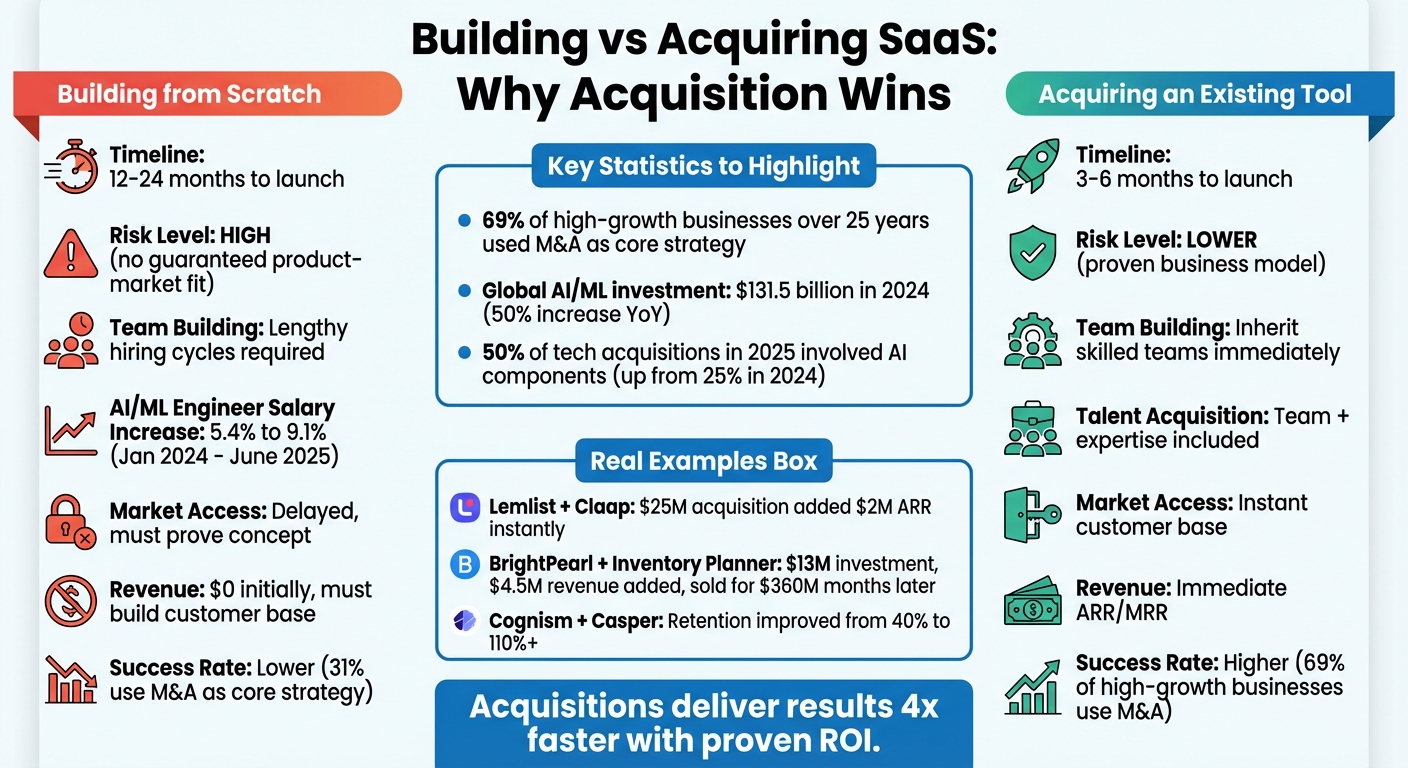
Building vs Acquiring SaaS: Timeline, Risk & Cost Comparison
Why Acquiring SaaS and AI Tools Beats Building
Instant Market Access and Revenue
Acquiring an established SaaS or AI tool can dramatically speed up your entry into the market. Instead of spending 12–24 months building from scratch, acquisitions can shorten this timeline to just 3–6 months[7]. Take BrightPearl's acquisition of Inventory Planner in August 2021 as a prime example. Under CEO Derek O'Connell, BrightPearl invested $13 million (at a 3.1× revenue multiple) to bring in an additional $4.5 million in revenue. This boosted their total revenue from $25.5 million to over $30 million. This strategic move not only strengthened their position but also set the stage for Sage's acquisition of BrightPearl for $360 million just a few months later in early 2022[2].
Beyond just faster market access, acquisitions also sidestep many of the risks tied to product development.
Reduced Risk with Proven Business Models
Acquisitions don’t just offer speed - they also lower the risks associated with building something new. When you develop a product from scratch, there's no guarantee of product-market fit. Buying an established tool or company, however, means you're inheriting a proven business model and a loyal customer base. For instance, Cognism faced challenges with customer retention, managing only a 40% retention rate under its direct sales model. To tackle this, they acquired Casper, a French PLG data provider with an impressive retention rate of over 110%, in March 2022. This acquisition not only improved Cognism's retention rates but also allowed them to expand into new markets like Spain[2].
"We had tried to build PLG internally but it hadn't worked out. We really needed to acquire that PLG expertise and have a part of our organization that was really good at it." - James Isilay, CEO, Cognism[2]
In fact, a study of 58 high-growth businesses over 25 years found that nearly 69% used mergers and acquisitions as a core strategy for scaling[1].
Once you’ve reduced the risks, the scalability of these tools can unlock even greater efficiencies.
Built-In Scalability and Lower Costs
Acquiring an existing tool also gives you scalability right out of the gate. Hiring AI or machine learning engineers is both expensive and time-consuming. Salaries for these roles increased by 5.4% to 9.1% between January 2024 and June 2025[3]. By acquiring a company, you not only gain the technology but also a team with the expertise and workflows already in place. This eliminates the long process of recruiting and onboarding.
For example, Mistral AI’s acquisition of Paris-based startup Koyeb in February 2026 didn’t just secure innovative serverless deployment technology - it also brought in a team of 13 skilled engineers. This move sped up the development of "Mistral Compute", their AI cloud infrastructure, positioning them to better compete with larger U.S.-based players[6].
"Koyeb's product and expertise will accelerate our development on the Compute front, and contribute to building a true AI cloud." - Timothée Lacroix, CTO and Co-founder, Mistral AI[6]
Similarly, the legal tech platform Clio demonstrated how acquisitions can deliver speed. After acquiring vLex, a legal research specialist with proprietary AI capabilities, Clio rolled out a unified product just 100 days post-acquisition[4]. Building such advanced AI capabilities from scratch would have taken years and significantly more resources.
sbb-itb-9cd970b
How to Find the Right Acquisition Targets
Metrics That Matter
When searching for the right acquisition target, it's crucial to focus on the numbers that truly reflect a company's health. Annual Recurring Revenue (ARR) is a good starting point because it shows stability, but it’s not the whole story. The Rule of 40 - where a company's growth rate and profit margin together equal or exceed 40% - offers a helpful way to balance growth with sustainability. For example, a company with 25% growth and a 20% margin meets this benchmark[9][10].
Net Revenue Retention (NRR) is another key metric. Companies with an NRR above 110% are usually strong candidates because it shows that existing customers are increasing their spending[10]. On the flip side, gross churn below 5% points to solid product-market fit. Metrics like Customer Acquisition Cost (CAC) payback periods and Customer Lifetime Value (CLTV) ratios provide insight into whether the business can scale efficiently. For mature SaaS companies, generating $200,000 to $250,000 in ARR per full-time employee is a good indicator of efficiency[9].
When it comes to AI tools, don’t get distracted by trendy buzzwords. Instead, focus on whether the company has proprietary models, unique datasets, or a proven return on investment for its customers.
"AI must be a moat - not a marketing tactic. At iMerge, we've seen acquirers walk away from deals where the AI story didn't hold up under technical diligence." - iMerge Advisors[10]
For profitable targets, look for gross margins above 70% and a median revenue multiple of 7.8x, compared to 6.7x for less profitable companies[9].
Using Marketplaces and Directories to Find Targets
Marketplaces can make the search for acquisition targets easier by offering access to vetted companies with clear metrics. Platforms like Acquire.com connect buyers with SaaS and AI startups, often integrating data from tools like Stripe and Google Analytics to verify financial performance[11][13]. This transparency reduces uncertainty and simplifies the evaluation process.
Some firms specialize in specific niches. For example, Agile Growth Labs focuses on AI and SaaS tools with ARR between $6 million and $50 million[8]. These platforms allow you to filter potential targets by factors like Monthly Recurring Revenue (MRR), churn rates, and tech stack, making it easier to find companies that align with your strategy[11].
"Acquire was instrumental in selling my SaaS business. I went out on my own at first to try to get offers without a broker, and I received 1 LOI. When I posted the business on Acquire, I got 6 LOIs, and I accepted an offer over asking." - Harris Osserman, founder of TalkHiring[11]
Look for products with strong potential but weak marketing. These under-marketed tools often represent great opportunities if you have the resources to scale their distribution.
"Look for companies with great products pointed in the wrong direction. If you have the go-to-market expertise they lack, you can negotiate a lower multiple and create massive value." - Derek O'Connell, former CEO of BrightPearl[2]
While these tools and strategies can help you identify promising targets, it’s equally important to watch for red flags that could complicate the acquisition.
Warning Signs to Watch For
Some warning signs can indicate a risky acquisition. High churn rates often point to weak product-market fit or dissatisfied customers[13]. If a single customer accounts for more than 30% of ARR, the business could face serious trouble if that customer leaves[10]. Another indicator to consider is Days Beyond Terms (DBT) - the number of days invoices are paid past their due date. Healthy companies usually keep DBT between one and five days, whereas larger businesses averaged 19 days in 2022[14].
Technical debt is another critical issue. Outdated technology, poorly written code, or systems that require significant investment to scale can drain resources after the acquisition[12][13]. If the product relies heavily on the founder’s involvement, transferring operations will be challenging. Similarly, dependence on a single acquisition channel, like high-cost PPC or referrals, without a strong organic presence, signals unsustainable growth[13].
Legal and compliance issues are deal-breakers for many buyers. Matthew Debbage, CEO of Creditsafe Americas and Asia, explains:
"If you see that a company has hundreds of lawsuits, over 20 court judgments, and dozens of tax liens, you know acquiring that business will be more trouble than it's worth."[14]
Ethical compliance is also essential, as nearly 90% of consumers prefer to buy from companies that follow ethical practices. Ignoring these issues can lead to reputational damage and lost trust[14]. Spotting these red flags early ensures you can maintain the speed and efficiency that make acquisitions such an effective growth strategy.
Due Diligence and Financing Your Acquisition
7-Step Due Diligence Process
Due diligence is your safeguard against costly acquisition missteps. It’s all about verifying the financial, technical, and operational details of the business you’re eyeing. Start with a financial audit. Dive into the last three years of profit and loss statements, balance sheets, and forecasts. Pay close attention to the revenue mix - how much is recurring (like subscriptions) versus one-time services? Ensure the reported ARR aligns with billing systems like Stripe and bank statements[19]. Any discrepancies here can delay the deal or reveal deeper issues.
Next, evaluate customer metrics such as MRR, ARR, retention rates, and CAC. These numbers will help you gauge margins and spot risks like revenue concentration. Also, review the sales pipeline and support systems to assess operational efficiency. For reference, healthy SaaS businesses often have gross margins between 70% and 90%, with an ideal CAC-to-LTV ratio of 1:3[17].
The technical review is where many buyers hit roadblocks. Check the readability of the source code, version control practices, and adherence to DRY principles[15]. Thomas Smale of FE International emphasizes:
"A premium SaaS business should have well-documented, annotated and tested source code. This is a must-have for investors looking at $500K+ businesses."[15]
Examine technical debt and the Bus Factor by reviewing code documentation and the reliance on key personnel[22][23].
For your intellectual property review, confirm ownership of all code, secure trademarks, and verify that developers and contractors have signed IP assignment agreements[15][17]. Undisclosed tax liens, lawsuits, or missing IP documentation can lead to unexpected liabilities[14][24].
Finally, audit human resources and compliance. Review employee data, worker classifications, and adherence to data privacy regulations like GDPR or HIPAA[16][17]. Ben Murray of The SaaS CFO notes:
"Many deals have failed because the executive team was not prepared for due diligence."[16]
On average, thorough due diligence results in a 23% adjustment to the initial price and could prevent 73% of failed deals[21]. Always secure a non-disclosure agreement before sharing sensitive data, and organize legal, financial, and product documentation in a virtual data room to streamline the process and build trust[16][17].
Once you’ve verified the business’s stability and potential, it’s time to focus on financing.
How to Finance an Acquisition
Acquisition financing often requires less upfront cash than starting from scratch. SBA loans, especially the 7(a) and 504 programs, are a popular choice for small-to-medium acquisitions. These loans require as little as 10% down and offer repayment terms of 7 to 25 years[18]. Fintech platforms are making the SBA application process faster and more accessible, with projections showing they’ll handle over 30% of SBA transactions by 2025[18].
Seller financing is another flexible option. Here, the seller finances part of the purchase price - typically with 0% to 50% down - and receives payments over time[18][20]. This approach reduces your upfront capital needs and signals the seller’s confidence in the business’s future. Similarly, earn-outs and performance-based payments tie part of the price to the business’s future performance, helping manage risk during the transition[18][20].
For businesses that don’t meet strict bank criteria, private credit is a growing alternative. With over $3 trillion in global assets under management, private lenders often base decisions on projected performance rather than just historical data[18].
Conventional bank loans work well for established businesses with strong financials. They offer competitive rates but typically require 20% to 40% down and have strict eligibility criteria[18]. However, approval rates are low - only 14.6% of small business loan applications were approved by large banks in 2024. This has pushed many buyers toward alternative financing methods[20]. Another option is asset-based lending, where the target company’s assets, like equipment or accounts receivable, are used as collateral for better loan terms[18][20].
The small business lending market is set to grow to $7.22 trillion by 2032, with digital and API-first lending solutions expected to capture 40% of the market by 2026[20]. The key is balancing debt to maximize returns while keeping enough equity to maintain stability during the post-acquisition phase[18].
With financing in place, you’re ready to focus on valuation and negotiation.
Setting Valuations and Negotiating Terms
SaaS businesses are typically valued at 3x–6x ARR, while mature companies fetch 5x–10x EBITDA. To justify premium multiples or creative deal structures, prepare a concise "Why Now" memo. This one-pager should explain why this target, at this time, is a rare opportunity. Highlight market trends, product advantages, and growth potential[19].
Amanda White, a SaaS acquisition expert, advises:
"The fastest way to lose a great offer is to look unprepared. Buyers expect a clean story, clean numbers, and evidence that the business runs without heroics."[19]
Double-check revenue figures to ensure reported ARR matches billing systems and bank statements. Revenue discrepancies not only delay deals but also erode trust[19]. During due diligence, look out for customer concentration risks - if more than 25% of revenue comes from a single customer, it can justify a lower valuation[17].
When negotiating terms, align the deal structure with your goals. If the seller is looking for a quick exit, you might negotiate a lower multiple for a faster close. If they’re invested in the business’s future, consider an earn-out where part of the payment depends on hitting specific revenue or retention milestones. In 2026, 68% of venture-backed exits under $50 million were strategic acquisitions rather than IPOs, showing that sellers are increasingly open to creative deal structures[5].
Integrating and Growing Your Acquired Tool
Transitioning Customers Without Losing Them
The first 100 days after an acquisition are critical for keeping your customers onboard. Start by segmenting your customer base by revenue contribution. For the top 20%, make personal phone calls to introduce the new ownership and reassure them. Mid-tier customers should receive personalized emails that acknowledge their unique relationship history, while the rest can receive a general announcement[29]. This tailored approach ensures you protect key relationships while managing communication efficiently.
When done right, integrations can help retain 85% to 95% of customers, but a poorly executed transition could result in losing 20% or more within the first year[29]. A great example is Cognism's acquisition of Casper, which successfully merged customer journeys and improved retention metrics[2].
During the first month, focus on building relationships and understanding customer needs. Avoid making any major changes to operations or software - disrupting established workflows could frustrate users[25]. For top-tier customers, schedule monthly check-ins throughout the first year to strengthen trust and address potential concerns early[29].
Reassure customers by emphasizing that the core team and key features remain intact, while also highlighting new resources that enhance their experience[29]. If price adjustments are on the horizon, be upfront about them. Provide a clear explanation and consider offering "grandfathered" pricing for loyal customers to ease the transition[26].
Once you’ve secured customer retention through thoughtful communication, the next step is to integrate the acquired tool seamlessly into your offerings.
Improving Features and Functionality
Integration missteps are a leading cause of acquisition failures, with 83% of them faltering due to poor execution[27]. Start by aligning foundational data models - like users, accounts, and transactions - before introducing new features. This ensures any AI enhancements can effectively work with the right data[30]. In fact, up to 85% of AI projects fail because of poor data quality and integration issues, not because of problems with the AI itself[30].
Take inspiration from Clio’s 2026 acquisition of vLex, a legal research platform. By embedding vLex’s data and AI into Clio’s core workflows, the company enabled lawyers to conduct research and apply findings within a single platform. Clio’s team reallocated R&D resources on day one and showcased the integrated product just 100 days later[4]. This success was driven by focusing on workflow-centric integration, embedding the acquired tool into high-value processes instead of treating it as a separate feature.
Before making any changes to the acquired team’s processes, observe what’s already working well. Rushing to alter their workflows could disrupt the very elements that made them successful[7]. When you’re ready to make updates, start with a proof of concept or pilot program for new AI features. This approach allows you to test value and refine governance before scaling up[31]. Companies that redesign workflows to integrate AI capabilities often see productivity gains of 2–3 times compared to those that don’t[30].
Focus on four main areas for AI integration: improving operational efficiency, adding incremental customer value, creating new products from proprietary data, and delivering AI-first services[31]. With nearly 50% of tech acquisitions in 2025 involving AI components (up from 25% in 2024)[4], integrating AI quickly can significantly enhance your company’s value.
Once the technical foundation is in place, you can explore new revenue opportunities through bundled offerings.
Creating New Revenue with Bundled Offerings
Bundling the acquired tool’s capabilities with your existing products can unlock new revenue streams. This often requires adjusting your sales strategy and pricing models to accommodate the bundled offerings[4]. For example, BrightPearl’s acquisition of Inventory Planner showed how bundling can increase both revenue and overall valuation[2].
Before rolling out higher prices for bundled services, test the new pricing model with a small segment - about 10% of your customer base. This allows you to measure the impact on churn and lifetime value[26]. Personalized calls-to-action during this transition can boost conversion rates by 42%, so tailor your messaging to specific customer segments instead of using a blanket approach[26].
Employee turnover can be a major challenge post-acquisition, with rates reaching 47% within the first year[29]. Losing key technical talent could derail your bundling strategy. To prevent this, offer "stay bonuses" or retention packages to critical team members who hold essential knowledge about the acquired tool[25][28]. Beyond financial incentives, inspire top AI talent by presenting their role as an opportunity to shape the industry, giving them a sense of purpose and vision[4].
21 Businesses Bought: How To Acquire A SaaS Business with Dirk Sahlmer
Conclusion
Buying an existing SaaS or AI tool can fast-track growth that would typically take years to achieve. Instead of spending months - or even years - proving product-market fit, you gain instant access to revenue, a proven customer base, and hard-to-find specialized talent. For context, global investment in AI and machine learning startups hit $131.5 billion in 2024, marking a 50% jump from the previous year[3]. This makes building such tools from scratch not just time-consuming but also incredibly expensive.
What’s the real takeaway here? It’s all about shifting your focus from the grind of product validation to creating real, strategic value. And the secret to successful acquisitions? It’s not just about the code. As Alex Boyd from Wildfront explains:
"Code is not a moat. Code is a commodity. What matters is: Community, Distribution, and Hard-to-get certifications"[32].
When scouting for acquisition targets, prioritize assets that are hard to replicate - like strong SEO rankings, a loyal user base, or regulatory certifications. These are the kinds of advantages that competitors can’t easily copy. Structuring the deal is just as important. Experts suggest a mix of 40–60% upfront payments with earn-outs tied to achievable 18-month milestones[32].
Once the deal is closed, the real challenge begins: integration. The first 100 days are critical in determining whether you’ll create or lose value[29]. Focus on segmenting customer communication by revenue impact, hold off on major feature updates for the first month, and prioritize reducing churn before chasing aggressive growth. Companies that take a methodical approach to integration often see a 40% boost in key SaaS metrics within a year and a 25%+ increase in enterprise value within two years[12].
Morgan Tate of Breakwater sums it up perfectly:
"If you cannot explain, in two sentences, exactly why this company is more valuable in your hands than in the seller's, you are not ready to bid"[33].
The magic happens when you find the right fit - an underutilized product that aligns with your customer base and go-to-market strategy. When done right, the results can be game-changing.
The fastest route to success isn’t building from scratch. It’s about strategic acquisitions, disciplined integration, and relentless scaling. By following these principles, businesses can leap ahead of competitors and achieve rapid, sustainable growth.
FAQs
How do I know if I’m ready to buy a SaaS instead of build?
When deciding between building and buying a SaaS solution, buying might be your best bet if creating the software in-house would take too much time, demand expertise or resources you lack, or push back your market entry. This approach works particularly well when the tool isn’t central to what sets you apart but is still crucial for scaling. It’s also ideal if you prioritize speed, minimizing risk, or taking advantage of a product that already fits the market. Just make sure the acquisition aligns with your broader strategic objectives.
What should I check first in SaaS due diligence?
Start by evaluating the strategic fit and synergy potential of the SaaS company. Does it align with your market positioning and operational goals? This step is crucial and should be integrated into a detailed due diligence process. Focus on key areas such as compatibility with your current operations and the potential for future growth opportunities.
How can I keep customers and key employees after the deal?
When a company goes through an acquisition, retaining both customers and key employees can be a challenge. The secret? Focus on the people and the culture that make the organization thrive.
Start by conducting a deep dive into the company’s culture before the acquisition. Understanding what employees value and what keeps customers coming back is critical. Once the transition begins, prioritize strategies that maintain engagement.
Here’s what works:
- Communicate clearly and often: Uncertainty can lead to anxiety. Regular updates help employees and customers feel informed and valued.
- Respect existing relationships: Long-standing connections - whether between employees or with customers - are the backbone of the business. Show appreciation for these bonds.
- Align cultural values: Ensure the acquired company’s values mesh well with yours. This alignment helps employees stay motivated and reassures customers that the service or product they love won’t change.
By putting people and culture first, you can smooth the integration process and keep both employees and customers loyal.