Sales looks glamorous, but the reality is stark: burnout, broken promises, and identity struggles plague the industry. Nearly 90% of B2B sales reps report exhaustion, and only 57% hit their targets in 2024. Salespeople spend 72% of their time on non-selling tasks, leaving them overwhelmed and unfulfilled. Overpromising to clients and misaligned teams worsen trust and retention issues, while relentless overtime fails to improve performance.
But there’s hope. Teams using AI tools saw 83% revenue growth and reduced administrative burdens. Clearer communication, achievable quotas, and prioritizing skills over numbers can reshape sales culture. The solution isn’t working harder - it’s working smarter, with tools and strategies that balance performance and well-being.
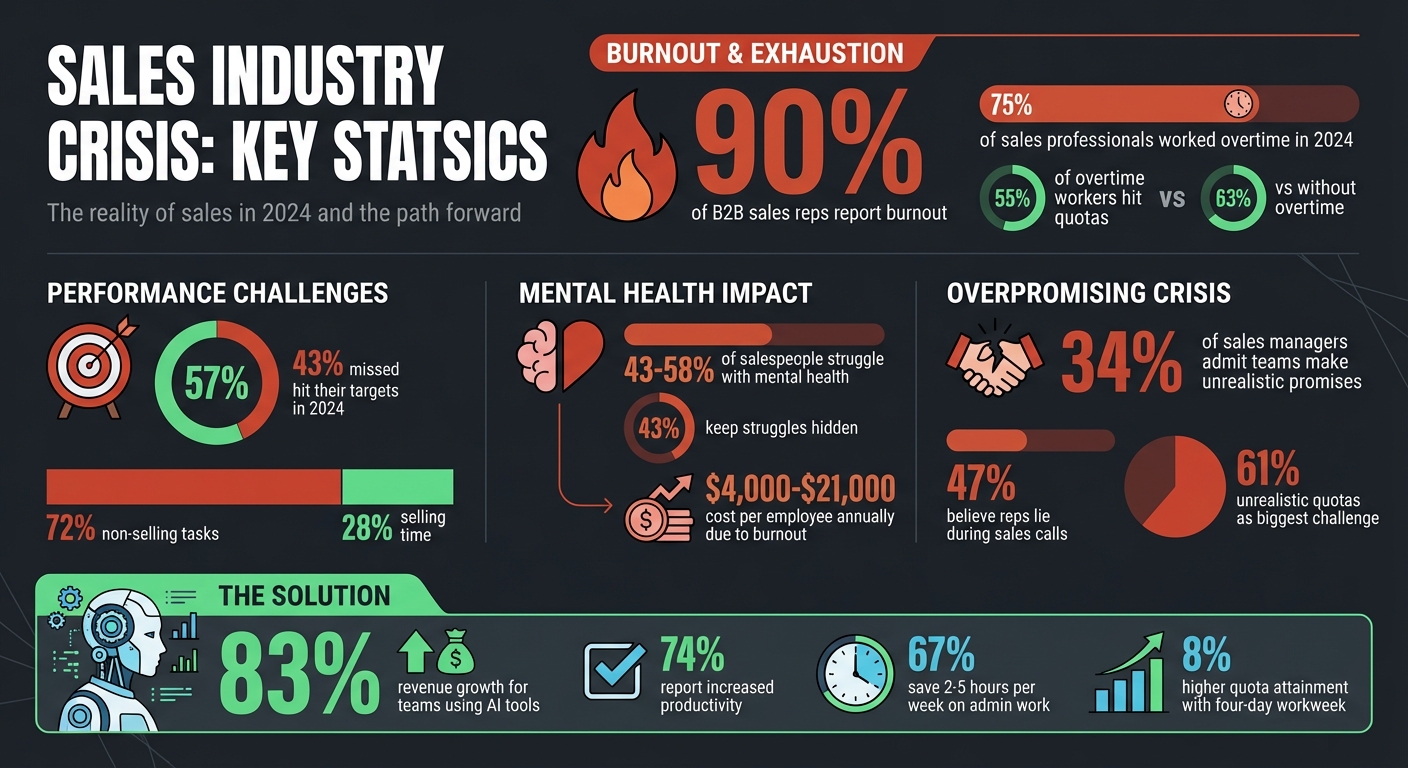
Sales Burnout Statistics: The Crisis in Modern Sales Teams 2024
Identity Crises in Sales: When Self-Worth Depends on Numbers
How Quotas Shape Professional Identity
In sales, your performance is always on display. Sales numbers are public, creating a "hero or zero" atmosphere where each deal seems to define your value [6].
Rejection in sales cuts deep, often leading reps to spiral from a single bad call to feelings of inevitable failure. Jeff Riseley, Founder of Sales Health Alliance, explains that this happens even when reps are performing well because their entire reputation and career hinge on meeting quotas [7].
The financial stakes only heighten the pressure. With performance-based pay, there’s no such thing as a "quiet day" to take it easy - every action directly affects your income [1]. Over time, this relentless grind leads to mental fatigue, especially when over half of sales reps - 57% - missed their quotas in 2023 [6]. The constant visibility of wins and losses doesn’t just create stress; it chips away at self-confidence, especially during down periods, fueling chronic sales anxiety [6].
What Causes Identity Confusion in Sales
The identity struggle in sales goes beyond individual quotas. Organizational factors amplify the problem.
First, failure in sales is immediate and public. Unlike jobs where mistakes can be buried in reports, a lost deal is visible to everyone [1]. This adds a layer of pressure that extends beyond personal earnings - it’s about keeping the business afloat.
Second, over-reliance on external motivators like commissions strips away autonomy and creativity. Jeff Riseley explains:
When a sales team is built only on extrinsic motivators, it erodes any sense of autonomy and creativity. The job boils down to a 'Do this to receive that' exchange [7].
Third, excessive administrative work frustrates reps and pulls them away from honing their core selling skills.
Lastly, there’s the loneliness factor. Even in team settings, the transactional nature of sales can breed isolation. This is reflected in the numbers: 43%-58% of salespeople report struggling with mental health, and 43% keep those struggles hidden [6].
How to Build Identity Around Skills Instead of Quotas
To combat these challenges, it’s essential to separate self-worth from short-term results. Sales leaders can guide their teams to focus on developing lasting skills, like active listening, technical expertise, and relationship building, rather than obsessing over targets.
A behavior-based management approach can help. Instead of fixating on dashboards and projections, managers should zero in on what reps are doing today. These daily, manageable actions lay the foundation for long-term success. As Jeff Riseley puts it:
If you're consistently looking at meaningful numbers four weeks from now, you're going to be more worried about what's happening in four weeks than what your rep is doing in the moment when they need the most support [7].
AI coaching tools are another resource worth exploring. These tools offer opportunities for roleplaying and real-time feedback, allowing reps to refine their techniques without the pressure of a live prospect [3].
Protecting time for professional development is equally important. Setting aside dedicated hours - like Friday afternoons - for testing new strategies or improving skills can shift the focus from commissions to personal growth [7].
Finally, celebrating wins that aren’t tied to quotas is a game-changer. Recognizing progress, such as building a new relationship, mastering a technical skill, or overcoming a tough objection, fosters a stronger professional identity. Matt Earle, Founder of The Selling Collective, highlights this point:
Mental health is not a 'nice to have' in sales. It's a performance multiplier [6].
Broken Promises: How Misalignment Damages Trust and Retention
The Cost of Overpromising to Clients
Overpromising doesn’t just cost you one client - it can ripple through your entire business. In B2B relationships, loyal customers feel the sting of betrayal more deeply when they’ve been misled. Research highlights that customers who feel deceived are not just likely to leave; they may also cut back on orders or spread negative feedback about your business [9].
The numbers are striking: 34% of sales managers admit their teams often make unrealistic promises [9]. Even worse, 47% believe their reps lie during sales calls, and 22% think their teams push unnecessary solutions just to hit targets [9]. These practices aren’t just unethical - they’re expensive. Take the Wells Fargo scandal from 2002 to 2016 as a cautionary tale. Employees, under immense pressure, opened millions of unauthorized accounts. The fallout? Over $3.7 billion in fines and a massive hit to the bank’s reputation [8].
Quota pressure is a major driver of overpromising. When reps feel the heat to hit their numbers, they might say whatever it takes to close a deal [2]. But this creates a vicious cycle: broken promises lead to customer churn, which ramps up pressure on future deals, leading to even more overpromising. It’s a pattern that not only erodes trust but also disrupts internal teamwork.
Why Sales, Product, and Customer Success Teams Get Misaligned
Overpromising often stems from deeper organizational issues. It’s not always about individual ethics - sometimes, it’s about how disconnected teams are. Sales teams may work in silos, with limited insight into what the product team can deliver or what customer success teams can support. Meanwhile, product teams may not know why deals are won or lost, and customer success teams are often left to clean up the mess without full visibility into what was promised.
This misalignment is more common than you’d think. Sixty-one percent of sales managers cite unrealistic quotas as their biggest challenge, which pushes reps to focus on closing deals at all costs rather than ensuring long-term success [1]. When quotas feel out of reach, the “always be closing” mentality can overshadow realistic delivery capabilities.
Adding to the chaos is the heavy administrative burden on sales teams. Reps spend just 28% of their time selling, with the rest consumed by tasks like reporting and scheduling [1]. This lack of time can lead to rushed discovery calls, incomplete documentation, and poor communication between teams. As Paulo Cunha, CEO of Pipedrive, puts it:
This strategy of throwing more hours at the problem is not working; there is a clear disconnect between hours worked and targets hit. Instead of fueling performance, relentless overtime is driving fatigue, underperformance, and imbalance [2].
Without a shared data source, each team operates on its own assumptions. Product teams develop features based on guesses instead of real feedback, while customer success teams scramble to manage expectations that were set long before they entered the picture.
Using SaaS Tools to Improve Transparency and Alignment
Bridging these gaps requires smart use of technology. SaaS tools can break down silos and create transparency - if they’re implemented thoughtfully. For example, automated win/loss reports shared across the company can help product and marketing teams understand what’s driving sales success (or failure) [1]. Commission automation platforms also give reps real-time insights into their earnings, reducing the desperation that often leads to overpromising [1].
AI tools are proving especially helpful for documentation. In 2025, M. Shannon Hernandez, founder and CEO of Joyful Business Revolution, introduced AI to streamline her sales process. By capturing key details during calls, she cut her post-call proposal prep time by 80%, turning a two-hour manual task into a quick, automated process [10]. She explains:
Instead of spending 2 hours consolidating notes into a proposal, AI now captures the key details live during my calls, which has cut my post-call time by 80% [10].
Here’s how these tools can transform workflows:
| Process Area | Before | After |
|---|---|---|
| Requirement Scoping | Reps rely on memory or manual notes, risking overpromising features | AI captures live call data, logging requirements in a shared CRM for Product and CS teams |
| Internal Alignment | Win/loss data stays siloed within sales | Automated reports share insights company-wide, helping Product and Marketing align |
| Quota & Commission | Opaque calculations lead to high-pressure "gaming" | Commission platforms provide clear, real-time earnings visibility and fair quotas |
| Administrative Load | Reps spend ~72% of their time on non-selling tasks | Automation handles lead routing, reporting, and scheduling, freeing up time for selling |
But it’s not just about automating tasks - it’s about rethinking workflows. As the 2025 Bain & Company Technology Report warns:
Automating mediocre processes only accelerates mediocre outcomes. Rethink selling activities and develop best-practice workflows [11].
When sales, product, and customer success teams operate with shared, real-time data, promises shift from hopeful guesses to commitments grounded in reality. This alignment not only builds trust but also strengthens the entire customer experience.
Burnout in Sales: Causes and Practical Solutions
What Burnout Looks Like in Sales Teams
Burnout in sales isn’t just a passing phase of tiredness - it’s a persistent state of exhaustion that impacts nearly 90% of B2B sales reps [1]. The signs are unmistakable: emotional fatigue, growing negativity toward clients, and a noticeable drop in performance. In a job where pay is often tied directly to results, every conversation feels like it carries financial weight, leaving little room for rest or recovery [1].
The relentless "always be closing" mindset blurs the line between work and personal life. Add to that the pressure of unachievable quotas - reported by 61% of sales managers - and burnout feels almost unavoidable [1][5]. The numbers paint a stark picture: in 2024, 75% of sales professionals worked overtime, yet only 55% of them hit their quotas, compared to 63% of those who avoided overtime [2][4]. Paulo Cunha, CEO of Pipedrive, sums it up perfectly:
Sales professionals are burning the candle at both ends, and it's not paying off... this strategy of throwing more hours at the problem is not working. [2]
The visibility of sales performance adds to the strain. Every failure feels magnified - not just as a personal setback but as a potential blow to the company’s success. The financial toll of burnout is staggering, costing organizations between $4,000 and $21,000 per employee annually due to turnover and lost productivity [12].
How to Manage Workload Without Burning Out
Spotting the signs of burnout is the first step, but addressing it requires rethinking how work gets done. The solution isn’t about working longer hours - it’s about working more efficiently. A staggering 72% of sales reps’ time is spent on administrative tasks, which can be streamlined using automation tools. Tasks like scheduling meetings, routing leads, and updating CRMs can be automated, saving reps 2 to 5 hours each week. Tools that provide commission transparency can also ease the mental strain of tracking earnings manually [1][2].
Managers can play a critical role by using project management software to monitor team workloads, ensuring top performers aren’t overburdened [12]. Interestingly, sales professionals on a four-day workweek are 8% more likely to meet their quotas compared to those on traditional schedules. This highlights that the problem isn’t about effort - it’s about unsustainable work practices [2]. Younger workers, especially those aged 18–25, are increasingly drawing firm boundaries by avoiding overtime [2].
Leadership also sets the tone for a healthier work culture. Late-night emails from managers can create an unspoken expectation for reps to be available 24/7. Tanya Channing, CPCO at Pipedrive, emphasizes this point:
Technology alone can't fix burnout. It's up to leaders to create a work culture that protects well-being, prioritizes work-life balance and ensures that progress doesn't come at the cost of people. [4]
AI Tools That Reduce Sales Team Burnout
While workload adjustments are crucial, modern AI tools offer a powerful way to alleviate burnout. Seventy-four percent of sales teams using AI report increased productivity by automating non-revenue-generating tasks [2]. From nurturing leads to qualifying opportunities and managing complex workflows, AI can handle these tasks with minimal human input [11][3][14].
The impact is clear: 67% of AI users save 2 to 5 hours per week on administrative work, and teams leveraging AI saw 83% revenue growth, compared to 66% for those without it [2][13]. However, there’s a downside - 66% of reps feel overwhelmed by their tech stacks, juggling an average of 10 tools just to close deals [13].
The solution lies in simplifying and integrating tools. Instead of piling on more disconnected software, companies should prioritize platforms that centralize data and workflows. AI-driven "Sales Coaches" can provide real-time feedback and roleplay opportunities, reducing the burden on managers and preparing reps for critical calls [3][14]. Automated commission platforms can eliminate the stress of unclear pay structures, while AI-powered lead routing ensures fair and efficient territory assignments [1].
| Strategy | Pros | Cons |
|---|---|---|
| Prevention (Yoga/Mindfulness) | Low cost; promotes overall well-being | Often ignored by those already experiencing burnout [1] |
| Automation (AI Tools) | Saves 2–5 hours/week; reduces admin work | Initial setup required; 35–40% of reps worry about data privacy [2] |
| Four-Day Workweek | 8% higher quota attainment | Challenging to implement in 24/7 sales environments |
| Commission Transparency | Builds trust; reduces mental stress | Requires investment in specialized tools |
With burnout affecting nearly 90% of sales reps, wellness apps alone won’t solve the problem [1]. Real progress comes from systemic changes like smarter automation, achievable quotas, and a fair workload. As Molly Clarke, Product Marketing Director at Salesforce, points out:
The sustainable answer to sales burnout comes in the form of technology – automation to be specific. [1]
But technology isn’t the whole answer. As Bain & Company highlights, the real game-changer is rethinking sales processes entirely, not just automating flawed systems [11]. When done right, AI doesn’t just save time - it gives sales reps the control and autonomy they need to perform at their best.
sbb-itb-9cd970b
Conclusion: Creating Sales Systems That Support People
Main Takeaways
Sales teams today face systemic challenges - identity struggles, unmet promises, and widespread burnout. With nearly 90% of B2B sales reps feeling burnt out, the cost to organizations is staggering: roughly $190 billion annually lost to turnover and reduced productivity [1]. The solution isn’t to push reps harder or send them to more wellness seminars. It’s about rethinking the way sales work is structured.
AI and SaaS tools can help, but only if used with care. Automation should take over time-consuming admin tasks, allowing reps to focus on what really matters: building relationships. Tools like commission transparency platforms reduce the stress of "shadow accounting", while algorithmic lead routing promotes fairness by eliminating human bias [1]. To make these changes effective, follow the 10/20/70 rule: dedicate 10% of your effort to algorithms, 20% to technology and data, and 70% to people and processes [14]. Without prioritizing the human aspect, even the best tools won’t deliver long-term results.
Ethical practices and high performance go hand in hand. For example, sales teams working four-day weeks are 8% more likely to hit their quotas [2]. Companies leveraging advanced AI have seen customer acquisition rates improve by up to 50% [14]. As Paulo Cunha, CEO of Pipedrive, explains:
It's not about working longer – it's about working better. Empowering people to focus on meaningful work, leverage smart tools, and protect their time isn't just good for wellbeing – it's essential for results [2].
These strategies offer a clear path to immediate and impactful changes.
Action Steps for Sales Leaders
To start improving your team’s performance and well-being, analyze their workload. Identify the non-revenue tasks eating up their time. Use automation to handle repetitive tasks like meeting scheduling, lead entry, and CRM updates - freeing up 2 to 5 hours per week per rep [2]. Introduce commission automation for real-time earnings transparency and implement AI-driven lead routing to ensure fair territory distribution [1].
But tools alone aren’t enough. Set up boundaries to protect your team’s mental health. Define clear work hours, encourage regular time off, and adopt schedules that respect work-life balance [2]. Offer ongoing training for AI tools to ease concerns about job security - 60% of reps worry about being replaced by technology [2]. Finally, redefine success to include skill-building and quality of work, not just hitting quotas. When you create systems that genuinely support your people, the results will naturally follow.
8 AI Sales Automations That Feel Like Cheating (PROVEN Systems)
FAQs
How can sales teams use AI tools to prevent burnout and improve productivity?
AI tools are transforming the way sales teams operate by taking on repetitive tasks, streamlining workloads, and offering actionable insights. By automating activities like data entry, lead scoring, and CRM updates, AI allows sales reps to focus their energy on meaningful interactions that directly impact results.
Beyond task automation, AI can keep an eye on workloads and flag potential signs of burnout. This helps managers step in and redistribute tasks before stress levels escalate. Virtual assistants and chatbots also play a key role by managing initial outreach, such as qualifying leads and scheduling calls, which lightens the emotional load for sales reps. Combined with supportive work policies - like flexible schedules and clear boundaries - AI can help create a healthier, more productive environment for sales teams.
How can sales leaders align their teams and avoid making unrealistic promises?
Sales leaders can strengthen alignment and avoid overpromising by focusing on three essential strategies:
- Set clear and achievable expectations: Lay out transparent guidelines for client commitments, ensuring promises align with what the team can realistically deliver.
- Use AI-powered tools effectively: Incorporate AI-driven workload management tools to balance tasks, monitor progress, and keep deliverables on track.
- Cultivate an ethical sales culture: Prioritize honesty by linking incentives to truthful outcomes and fostering a team atmosphere where integrity takes precedence over short-term gains.
These approaches help sales leaders build trust, boost team morale, and establish a solid foundation for long-term success.
How can sales professionals build an identity beyond just meeting quotas?
Sales professionals can create a strong professional identity by emphasizing the value they provide to clients rather than obsessing over hitting numbers. When you focus on solving customer challenges, delivering meaningful results, and building genuine trust, you position yourself as a trusted advisor - not just someone chasing quotas.
Investing in personal growth is another cornerstone of success. Build your expertise by honing your skills, whether that’s mastering AI tools or becoming a go-to expert in your industry. Transparent, relationship-focused communication also plays a critical role. Setting realistic expectations and consistently following through on promises helps establish trust as the foundation of your professional reputation.
To maintain balance and avoid burnout, leverage tools like AI-driven automation to take care of repetitive tasks and set clear boundaries around your work hours. Incorporate regular breaks, schedule time off, and create a clear divide between work and personal life. By concentrating on solving problems, earning trust, and sharing your expertise, you’ll maintain a strong professional identity - even when sales targets shift.