Starting a startup? Your first 48 hours are critical. Instead of wasting time on negotiations or partnerships, focus on execution and validation. Here’s the key takeaway: speed matters more than perfection. Launch fast, test your idea, and connect with users to build momentum. Early negotiations often waste time and put startups at a disadvantage. Delay commitments until you have traction and leverage. Here's how to maximize your first 48 hours:
- Launch quickly: Build a landing page, onboard users, and set up basic tools like analytics.
- Talk to users: Identify their pain points and validate demand through direct feedback.
- Track performance: Use tools like Mixpanel or Hotjar to monitor behavior and optimize.
- Avoid distractions: Skip lengthy negotiations and focus on building and iterating.
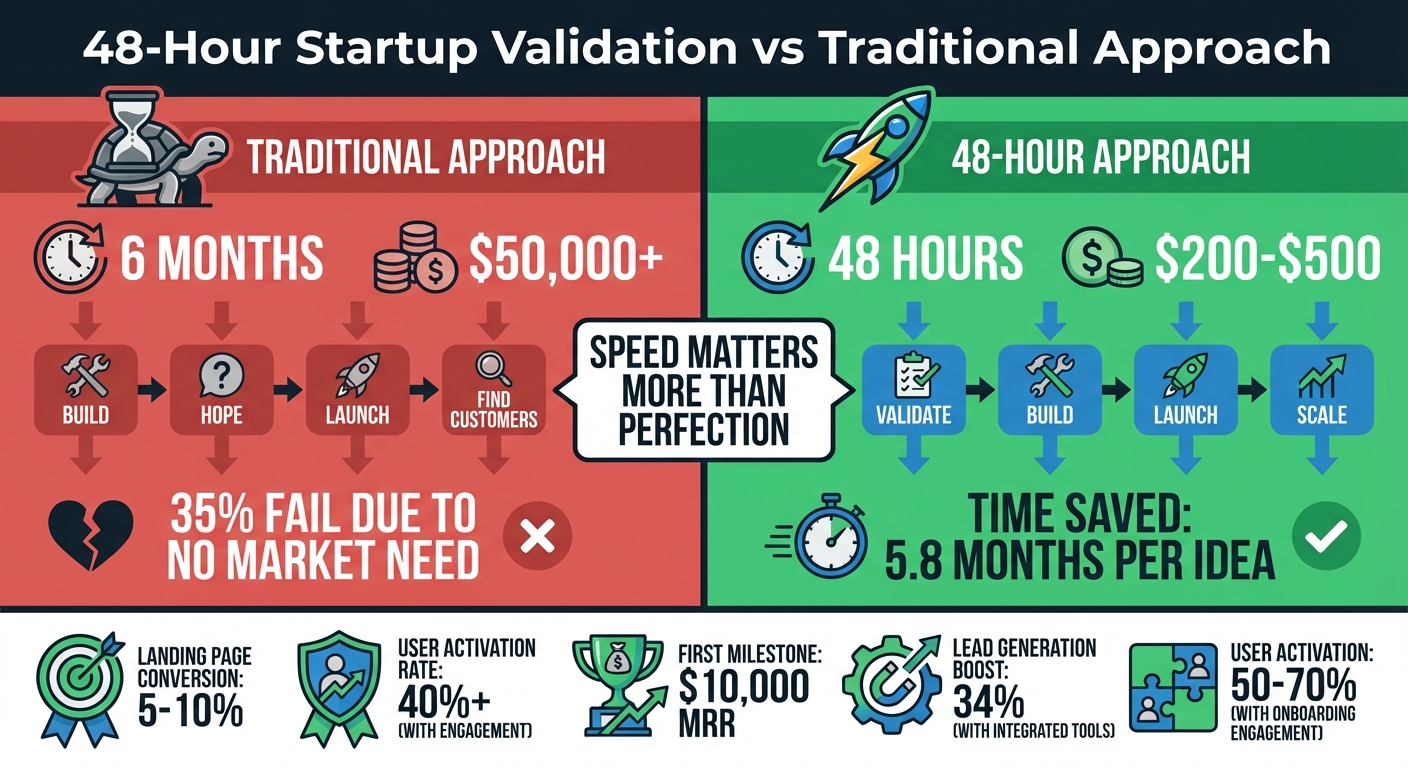
Traditional vs 48-Hour Startup Validation: Cost and Time Comparison
How To Start A Business In 48 Hours - Noah Kagan
sbb-itb-9cd970b
Step 1: Execute First, Negotiate Later
In the early stages, your first 48 hours should be all about tasks that drive growth. Geoff Ralston, former President of Y Combinator, sums it up perfectly:
The most important tasks for an early stage company are to write code and talk to users. [9]
Everything else is a distraction from what truly matters - execution.
Set Clear 48-Hour Goals
Forget about polished pitch decks or lengthy plans. Instead, focus on actionable, measurable goals. For example, you might:
- Launch a landing page.
- Conduct five user interviews.
- Set up a basic analytics dashboard.
- Onboard your first three customers. [1]
The key is to embrace a "90/10" mindset: aim to achieve most of your goal with minimal effort. For instance, a basic landing page built in two hours using a template is far more effective than a custom-designed site that takes two weeks. A "good enough" solution available now beats a perfect one that arrives too late. [2][9] Once your goals are set, use the right tools to execute them swiftly.
Leverage SaaS and AI Tools for Speed
Using the right tools can save you time and energy, allowing you to focus on what matters most. Stick to proven, efficient options for rapid deployment. For example:
- Next.js for your framework.
- Tailwind for UI.
- Clerk or Auth0 for authentication.
- Stripe for payments. [8]
No-code platforms like Bubble or Webflow can get you up and running in just one to two weeks for $100–$500 per month. [7] Automation tools like Zapier can handle repetitive tasks, such as managing email sequences or social media posts, so you can concentrate on strategy instead of busywork. [1] AI tools can also streamline development, generating form skeletons, CRUD API routes, or documentation, saving you 30–90 minutes per task. [8]
Startups that use integrated platforms report a 34% boost in lead generation within six months. [1] Yet, many teams waste 60% of their time switching between fragmented tools. [1] Consolidate your stack early - using something like Stripe Atlas can give you access to $50,000 in partner credits and discounts on essential tools. [6] Every minute saved on tool-switching is a minute you can spend talking to users. With your tools in place, you’re ready to move fast and iterate.
Prioritize Speed Over Perfection
When launching, speed matters more than perfection. Your product doesn’t need to be flawless; it just needs to solve one specific problem well enough for someone to use. [2][9]
Testing your idea quickly can save you months of wasted effort. You can validate an idea in about 48 hours, compared to six months with a traditional "build first" approach. The cost difference is just as stark: $200–$500 to test your market versus $50,000 or more to build something no one might want. [5] As ShipAi puts it:
Done is better than perfect when it comes to MVPs. [7]
Avoid distractions that pull you away from core execution - things like conferences, networking dinners, or extended negotiations with large companies. [2] Deals with big corporations often take too long, cost too much, and rarely succeed for startups. [9] Instead, focus entirely on building and iterating. By executing quickly, you’ll gain the leverage you need when it’s time to negotiate later.
Step 2: Validate Your Product and Get Your First Customers
Once you've taken swift action to launch, the next step is all about proving that there’s real demand for your product. Why is this so crucial? Because 35% of startups fail due to building products with no actual market need [11]. In the first 48 hours, your goal is to connect with potential users and confirm that your product solves a real problem.
Connect Directly with Your Target Audience
After your rapid launch, shift gears to focus on proving demand. Start by identifying who needs your solution and where they spend their time online. A great method to use here is the "Sales Safari" approach: dive into niche communities like Reddit, Discord, or industry-specific forums where your potential customers are already talking [16][17]. Pay attention to recurring pain points and note the exact language people use to describe their frustrations.
For example, you can use targeted Reddit searches like site:reddit.com [your problem] -solved to find discussions where users are actively seeking solutions [17]. Join three highly active communities and contribute by answering three to five questions daily - without pitching your product. This helps you build credibility and trust [17]. Once you've established some rapport, send 20–30 personalized messages or emails, framing your outreach as a request for "Founder Feedback." Ask for a quick 15-minute chat to better understand their pain points [17][18].
Paul Graham from Y Combinator emphasizes the importance of this hands-on approach:
At the start, recruit users manually and give them an overwhelmingly good experience. Then they'll tell their friends [16].
Remember, early adopters are more forgiving of product imperfections as long as you're genuinely solving their problems [16][17]. Avoid relying on friends or former colleagues as test users - they’re often biased. Instead, focus on individuals who have objective criteria for evaluating your product [11].
Track Analytics and Gather Feedback
From the moment users start interacting with your product, you need to track their behavior. Tools like Mixpanel (free for up to 20 million events per month) or Amplitude (starter plan at $49/month) can help you monitor specific events and conversion funnels [12]. For a closer look at user behavior, use tools like Hotjar (free basic plan or $29/month for Plus) to watch session replays and pinpoint exactly where users are dropping off [12][14].
To get direct user feedback, deploy micro-surveys through platforms like UserGuiding or Userpilot. These tools allow you to collect emoji ratings or Net Promoter Scores (NPS) right after user interactions [12][13][14]. Why is this important? Products that actively engage users during onboarding tend to activate 50–70% of new users, compared to just 20–30% without these tools [13].
You can even automate the process of synthesizing feedback. Export user comments from Slack or email and use tools like ChatGPT or Claude every two weeks to categorize common themes and identify major roadblocks [15]. Aim for an activation rate of 40% or higher, meaning users are achieving the core value of your product during onboarding. This is a critical milestone before you shift your focus to scaling up acquisition efforts [16].
Create Momentum with Early Customer Wins
Landing your first paying customers is a huge milestone. Not only does it validate your market, but it also creates social proof. One effective way to secure these early wins is by using a "Concierge MVP" approach. Essentially, you solve the customer’s problem manually behind the scenes before automating anything [16]. This hands-on method helps you secure revenue early on while giving you valuable insights into what your product needs to deliver.
To build urgency, consider running campaigns like "Founding Member" tiers or "First 100 Only" offers [17][18]. You can offer lifetime discounts - such as $9/month for life - to your first 20–100 customers. Adding visible counters showing how many spots are left can create a sense of scarcity and encourage quick action [17][18]. As Sam Altman from Y Combinator puts it:
It’s better to have 100 users who love you than 1,000 who just like you. Start with a small market you can dominate [16].
Step 3: Delay Commitments Until You Have Leverage
After launching quickly and proving there's a demand for your product, the next challenge is maintaining your momentum without rushing into premature partnerships. It’s tempting to jump at early opportunities, but holding off on commitments until you have leverage can save you from potential pitfalls.
Risks of Early Partnerships
Getting into partnerships too soon can leave you vulnerable. Without solid traction, it’s hard to command respect or negotiate favorable terms. Many deals between startups and larger companies fail because they take too long to finalize and drain resources [2].
Unlike a feature you can tweak or remove, contracts are much harder to renegotiate. If you agree to terms like giving up too much equity or signing restrictive exclusivity clauses, you could limit your company’s growth. Poorly structured agreements are a common reason for founder departures, with 20% of founders leaving due to such issues [4].
Negotiate from a Position of Strength
The key to successful negotiation is timing. You need to wait until you have something that potential partners genuinely value - whether it’s revenue growth, an engaged user base, or clear momentum. Vaibhav Totuka from Qubit Capital explains it best:
Negotiation is not only about 'getting a deal done.' It is about structuring a deal you can defend over time [4].
Preparation plays a huge role in securing better outcomes. Having your financial projections, cap table, and KPIs ready can improve deal success rates by over 30% [19]. When you approach negotiations armed with data - like a 5–10% landing page conversion rate, steady revenue growth, and strong user retention - you’re not just pitching an idea; you’re presenting a solid opportunity.
Another powerful tactic is creating competitive tension. Instead of negotiating with one potential partner at a time, engage multiple parties simultaneously. This adds urgency and strengthens your ability to walk away from unfavorable offers. A strong BATNA (Best Alternative To a Negotiated Agreement) is crucial here. As noted by Strtly:
The greater your BATNA, the more leverage you safely hold [19].
Once you’ve built this leverage, use key performance indicators to determine when your startup is ready to start serious negotiations.
When to Start Negotiating
So, how do you know it’s the right time to negotiate? Use these milestones as your guide:
| Readiness Signal | Metric/Indicator | Why It Matters |
|---|---|---|
| Market Demand | 5–10% Landing Page Conversion [21] | Confirms your value proposition resonates. |
| User Love | High Retention & Organic Referrals [20][21] | Shows you’ve achieved product-market fit. |
| Financial Viability | $10,000 MRR (for SaaS) [20] | Positions you strongly for investments or deals. |
| Operational Focus | Core "Must-have" Features Completed [21] | Proves you can deliver without overcommitting. |
| Leverage | Strong BATNA [19] | Ensures you can walk away from bad terms. |
Many bootstrapped SaaS founders aim to hit $10,000 in monthly recurring revenue before considering investors or major partnerships [20]. This milestone isn’t arbitrary - it’s proof your business model works and gives you the leverage to negotiate without desperation. Until you reach that point, focus on what Sam Altman calls the universal job of every CEO:
to make sure the company wins [22].
Winning means building, shipping, and refining your product - not getting bogged down in endless negotiations that might not lead anywhere.
Conclusion: The 48-Hour Approach to Startup Success
The first 48 hours lay the groundwork for every future negotiation. While traditional methods can burn through months and over $50,000 just to test an idea, a rapid validation approach costs only $200–$500 and delivers results in just 48 hours - saving an average of 5.8 months per idea [10].
The secret to this speed? Strategic clarity. As Ankit Goyal says:
Speed doesn't come from code. It comes from clarity. [23]
Clarity is about pinpointing the problem you're solving, identifying your target audience, and confirming they're willing to pay for the solution.
This clarity is what makes the 48-hour playbook so effective. It flips the traditional startup model on its head. Instead of building a product and hoping for customers, you validate demand first, secure your initial users, and create momentum. This approach allows you to negotiate from a position of strength. It’s why 73% of early-stage startups now outsource their initial development - to focus on speed and efficient use of capital [21]. It’s not about cutting corners; it’s about cutting distractions.
By focusing on execution and validation early, you create the systems needed to track progress, make informed decisions, and build trust with investors and your team [3]. When it’s time to negotiate - whether for funding, partnerships, or key hires - you’ll have the traction, data, and leverage to make deals on your terms.
The formula is simple: execute, validate relentlessly, and let the data guide your commitments. That’s how winners secure their edge.
FAQs
Why should early-stage startups hold off on negotiations?
In the first 48 hours of launching your startup, the focus should be on getting things done, validating your product, and attracting customers. Diving into negotiations too soon can backfire, leading to partnerships or agreements that might not align with your long-term vision - especially if you’re still figuring out what your customers actually need.
Instead, channel your energy into gathering customer feedback and making quick adjustments. This approach helps lay a solid foundation for your business. Rushing into commitments too early could box you into unfavorable terms or limit your ability to adapt as your startup grows. Concentrate on proving your idea works and delivering value before worrying about deals.
What’s the fastest way to validate my startup idea?
When you're testing out your startup idea, the key is to act fast and keep it simple. Start with customer interviews to uncover genuine needs, build a straightforward landing page to measure interest, or put together a basic prototype to validate your main assumptions. Try to wrap up these steps within 7–14 days to get quick feedback.
To save time, use tools that make things easier, like no-code platforms or online survey tools. Your main objective here is to gather just enough data to confirm there's demand and fine-tune your idea - before committing too much time or money.
What are the best tools to help founders move quickly in the first 48 hours?
To hit the ground running during the critical first 48 hours of launching a startup, having the right tools can make all the difference. Notion AI is a standout option for handling documentation, organizing your ideas, and simplifying workflows. With its AI-powered features, it takes care of repetitive tasks and keeps all essential information in one place, allowing founders to focus on what truly matters - execution. For teams that thrive on visual collaboration, Miro is a fantastic tool. It helps brainstorm, plan, and refine ideas in a dynamic and efficient way.
When it comes to task management, platforms like Trello and Asana shine. They make it easy to set up agile workflows, prioritize tasks, and monitor progress - all crucial for staying on track. To maintain your online presence without getting sidetracked, social media automation tools can schedule and post content for you, saving valuable time. And for tackling more complex tasks, no-code and AI-driven automation tools are a lifesaver, especially for small teams or solo founders who need to move fast without a lot of resources.
These tools are designed to help you zero in on what matters most in those early hours: rapid execution, validating your product, and engaging with customers.